
Short answer: a Google Ads trademark complaint controls how your mark appears in other advertisers' ad text. It doesn't stop anyone bidding on your brand as a keyword. Google's own policy lists "Using trademarks as keywords" among the uses it will not restrict.
That makes the complaint useful against impostors and misleading ad copy, and weak against affiliates bidding on your brand. An affiliate on "[brand] promo code" doesn't need your mark in the ad. A coupon site can write "Save 20% today, codes checked daily" above its own domain and still take the click. There is nothing in that ad for a trademark complaint to act on.
What works against affiliates is contract: your program terms, enforced through the network, with Google's Unfair advantage policy behind them. That policy lists "Affiliates that advertise on Google Ads against the applicable affiliate program rules" as not allowed. This piece covers what the complaint does, how to file it, what Google's URL and business name rules mean for affiliates (both changed in 2026), where Microsoft differs, the legal backdrop, and the order to act in.
I run AdCrime, and we sell monitoring of paid ads on branded coupon searches, which is the evidence step in the sequence below, so weigh the argument accordingly. Policy wording comes from Google's and Microsoft's own pages, checked on 9 October 2026, with Google's trademark, destination, Unfair advantage and business name pages checked again on 2 November 2026; the one number is from our data.
What a trademark complaint covers
Google's Trademarks policy says that when an owner complains, Google will review it "and may restrict use of the trademark". It then sorts uses into what it will and won't restrict. It will restrict two things:
- "Using trademarks in an ad from a direct competitor"
- "Ads that use the trademark in a confusing, deceptive, or misleading way"
It will not restrict, among others:
- "Using trademarks as keywords"
- "Using trademarks in the second-level domain of the ad's display URL"
- Ads whose landing page mainly sells the trademarked products, or mainly gives "informative details" about them "or an index of search results related to the trademark"
- "Ads that use the trademark descriptively in its ordinary meaning"
The mark also has to appear in the ad: "The trademark must be used in the ad, not only on the ad's landing page."
The scope narrowed in 2023. Google announced that from 24 July 2023 it "will no longer accept complaints against all advertisers in the trademark owner's industry" and would process complaints "against specific advertisers and/or ads". Older restrictions were to be "gradually phased out for most advertisers over the next 12-18 months" (Search Engine Land covered the change on 8 June 2023). If your protection still leans on an industry-wide complaint filed years ago, assume it no longer does the work.
Today Google "will only accept complaints against specific advertisers identified on the basis of their URL(s)", in the countries and industries where you have shown trademark rights. An upheld restriction is generally "applied on an ongoing basis in any ads that use the same second-level domain" in their final URL. And it isn't instant: Google warns at least 7 days before it suspends an account.
One setting often gets mistaken for protection. Brand exclusions and inclusions are controls for your own Search and Performance Max campaigns. They "keep your campaigns from serving for branded queries you want to avoid," and do nothing to anyone else's ads.
Why it barely touches affiliate brand bidding
Put the policy next to what an affiliate on your coupon searches actually does.
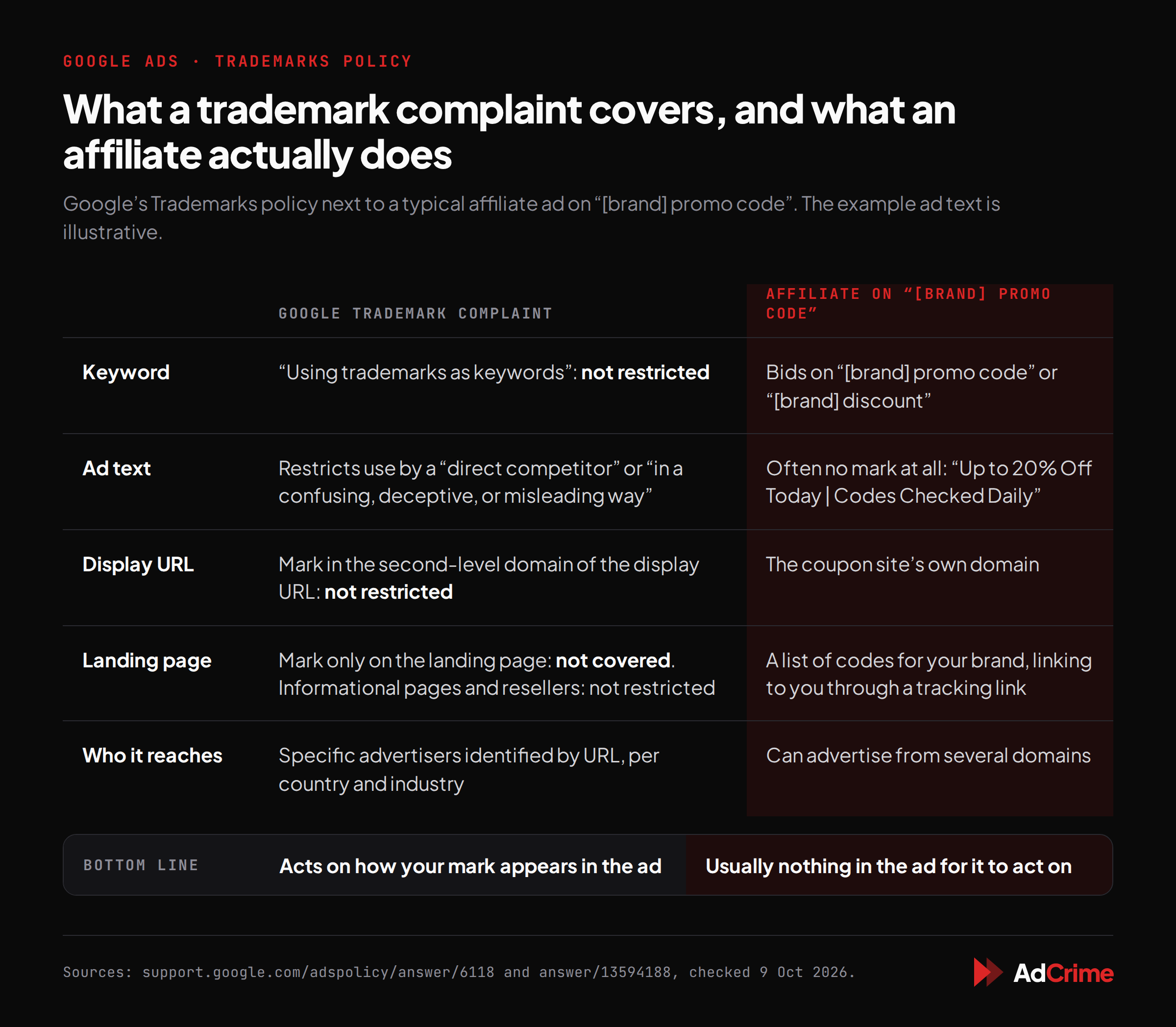
- The keyword. The affiliate bids on "[brand] promo code" or "[brand] discount". Keyword use isn't restricted.
- The ad text. Often it doesn't name you: "Up to 20% Off Today | Codes Checked Daily". With no mark in the ad, there is nothing to restrict. If it does say "[Brand] Promo Codes", the landing page is a list of codes for your brand, which sits close to the informational exception, and whether that exception applies is Google's call. An affiliate also isn't a "direct competitor".
- The display URL. The coupon site's own domain. Even a domain with your mark in it is listed as not restricted.
- The advertiser. Complaints name advertisers by URL. An affiliate that advertises from three domains is three complaints.
Direct linkers, affiliates that send the click straight through a tracking link to your site, are a different problem. Google's destination requirements say ads must "accurately reflect which app or website the user is being directed to". Examples of a mismatch include a display URL domain that "doesn't match the final and mobile URLs" and "Redirects from the final URL that take the user to a different domain". Thin bridge pages fall under "Destinations that are solely designed to send users elsewhere".
So a direct linker either shows your domain in its ad, or breaks those rules and has to keep the redirect out of sight of review (how affiliates hide brand bidding covers the usual methods). A complaint that identifies the advertiser by its URL fits badly when the URL in the ad is yours. The destination rules and the Unfair advantage policy fit better.
One change to know: since July 2026, Google allows a redirect from the final URL to a different domain "in certain circumstances, with prior approval" (the June 2026 update). Its example is a manufacturer sending shoppers to an approved list of retailers that stock the product. The update doesn't mention affiliates, and the destination requirements page still lists cross-domain redirects as a mismatch. When you report a direct linker, the question for Google is whether that redirect was ever approved.
This is not an edge case. In public Google results from 19 February to 25 September 2026, we recorded 71,482 paid ads on branded coupon searches for the brands we scanned (not a sample of all brands). 43% of them sent the click through the brand's own affiliate program. For those ads you aren't dealing with a stranger misusing your mark. You are dealing with a partner you already pay, under a contract you wrote.
Google's affiliate rule is Unfair advantage
Google's Unfair advantage policy lists "Affiliates that advertise on Google Ads against the applicable affiliate program rules" among the things it doesn't allow. Google updated the policy on 14 April 2025, and the affiliate line is in the current version. The same policy lists "Trying to show more than one ad for your business, app, or site in a single ad location", which is worth citing when an affiliate's ad points at your own domain.
Two things follow. The rule is only as strong as your terms: Google enforces "the applicable affiliate program rules", so if yours don't clearly ban brand bidding, there is nothing to break. And it starts with a warning at least 7 days before any suspension. The policy page doesn't say how Google learns what your rules are, so quote the clause when you report.
Impostors fall under a heavier rule. Google's Misrepresentation policy lists "Impersonating other brands or businesses" and making it seem you're "supported by another brand" as unacceptable business practices. Google treats those as egregious, so the account can be suspended on detection without a warning. An ad that calls itself your "official site" belongs here.
The name shown above the ad is covered too. Google's business name rules already require it to match the advertiser's domain or verified name. An October 2026 update lets the two differ in some limited cases, and says resellers, booking intermediaries and "affiliate distributors" don't qualify: they are "prohibited from using the standalone brand name" of the products they offer as their business name. An affiliate whose ad runs under your brand name alone breaks that rule even when its ad text never names you, so capture the business name in your screenshot.
Anyone can report an ad. Google's how to report an ad page lists the Report ad option on the ad itself, a Report an ad form, and "Report this ad" in the Ads Transparency Center. You get an email confirmation, and Google reviews the ad.
How to file a trademark complaint
The Trademarks policy sends owners to Google's Report Content On Google troubleshooter. The form behind it changes, so I won't list its fields. From the policy itself, have this ready:
- Your registration details for each country where you want the restriction.
- The specific advertiser's URL. Industry-wide complaints are no longer accepted.
- Dated screenshots showing your mark in the ad text, with the market and the query.
- Why the use is confusing or misleading, since keyword use alone is out of scope.
The Ads Transparency Center, which Google launched in March 2023, helps with the advertiser. You can search by advertiser name or website and see "Which ads were shown in a certain region" and "The last date an ad ran". It doesn't show which keywords an ad was bought on.
Microsoft Advertising
Microsoft takes trademark concerns through its own intellectual property concern form. "You must be legally authorized to act on behalf of the owner" of the mark, and the relationship options include employee, attorney and an advertising agency representing the brand. The form asks for a registration number, which search engines showed the ad (Bing, Yahoo or other), "the exact phrase used in the search box", and the ad title, ad copy and display URL. Several ads go in one spreadsheet. It covers ads only: "Microsoft does not remove organic search results in response to a trademark complaint." By signing, you accept that the submission "may be provided to third parties."
Microsoft's trademark policy is separate from Google's. I couldn't confirm its current handling of keyword complaints by market on a live Microsoft page, so check it for your markets rather than assume Google's rules carry over. For affiliates it matters less: if your terms say "any search engine", Bing is covered by contract.
The legal backdrop, briefly
This is not legal advice, and the law differs by country. The pattern in the cases most often cited:
- EU. In Google France v Louis Vuitton (CJEU, Joined Cases C-236/08 to C-238/08, 23 March 2010), the court held that Google, as the referencing service, does not use the mark itself. An advertiser using an identical keyword can be stopped where the ad "does not enable an average internet user, or enables that user only with difficulty, to ascertain" whether the goods come from the trademark owner. Interflora v Marks & Spencer (C-323/09, 22 September 2011) applied that reasoning to a competitor's keyword ads.
- US. In 1-800 Contacts v JAND (Warby Parker), the Second Circuit held in 2024 that buying a rival's mark as a keyword "cannot support a claim of trademark infringement absent additional use" of the mark (Goodwin's summary). In Lerner & Rowe v Brown Engstrand & Shely (October 2024), the Ninth Circuit found a rival law firm's keyword ads, labeled "Ad", unlikely to confuse (IPWatchdog).
Buying the keyword is generally lawful. Liability turns on what the ad says and where it lands.
For affiliates, you rarely need any of this. Whether a sale earns commission is decided by your program terms, not by trademark law. One check is worth doing: if your agreement licenses your marks to affiliates, make sure the license excludes paid search, so nobody can argue your own contract authorized the ad.
What to do, in order
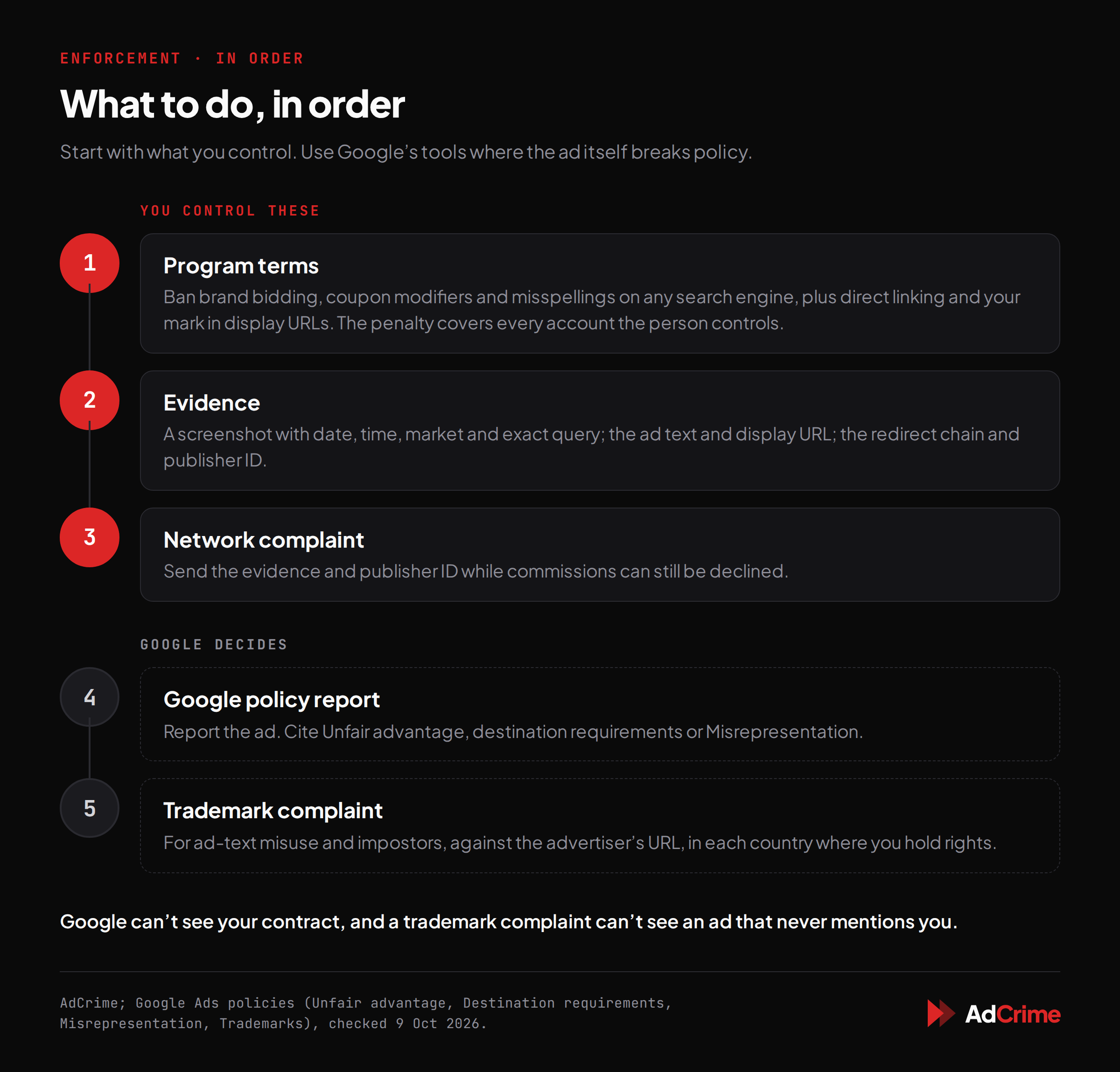
- Program terms first. Ban bidding on your brand, its misspellings and variations, alone or with words such as coupon, promo code, discount or voucher, on any search engine. Ban direct linking from paid search, your mark in display URLs and domains, and copy that implies official status. State the consequence (forfeited commissions, removal) and apply it to every account the same person or company controls. The policy template has clause wording.
- Evidence. A screenshot of the results page with the date, time, market and exact query. The ad text and display URL, copied out. The redirect chain from the click to your site, and the publisher ID it carries (reading the redirect chain shows where to look). One sighting is easy to dispute; several dated ones are harder.
- Network complaint, inside the reversal window. Send the evidence and publisher ID to the network while commissions on those sales can still be declined. Once the validation window closes, getting money back is harder. Ask for declined commissions, a warning or removal, and a written reply.
- Google policy report, where the ad itself breaks policy. Use the Report an ad form or the Ads Transparency Center, and name the policy: Unfair advantage with your clause quoted, destination requirements for a redirect to a different domain, the business name rules for an affiliate using your brand as its business name, Misrepresentation for impersonation.
- Trademark complaint, for ad-text misuse and impostors. When the ad text uses your mark in a confusing or misleading way, or an advertiser poses as you, file against that advertiser's URL in each country where you hold rights.
Steps 1 to 3 come first because they are the ones you control. Google can't see your contract, and a trademark complaint can't see an ad that never mentions you.
If you want to know who is bidding on your brand in Google, the first scan is free.
Mario Vaher is the founder of AdCrime, which traces paid ads on branded coupon searches (public Google results, followed down the redirect chain) to the network and publisher account behind each one.