
Short answer: when an affiliate bids on your brand's coupon search and wins the click, Google still charges the affiliate for it. You pay later, in commission, on any sale the affiliate gets credit for. An affiliate that keeps buying those clicks is probably earning more per click than Google charges it, and much of that is likely your commission. Whether that costs you more than buying the click yourself, or than the free click on your own organic result, is a comparison you can run on your own numbers. In our data, most brands weren't buying those searches at all.
PPC teams have argued for years about whether to pay for their own brand name. There is good experimental evidence on that question, and we'll get to it. What the argument rarely prices is a case we see constantly: on "[brand] promo code", the ad above your organic result often isn't yours or a competitor's. It's an affiliate in your own program.
I run AdCrime, and we sell monitoring of exactly these searches, so weigh the argument on its evidence rather than my word. The comparison near the end needs nothing from us.
What was on the page
Since late September we have recorded every ad on the results pages in our data, the brand's own included. Between 27 September and 16 October 2026, 5,792 Google results pages for branded coupon searches carried at least one ad. 2,737 of them (47%) carried an ad from a site our scans traced, on that same brand, through the brand's own affiliate program (a confirmed or likely interception). Those pages cover 2,080 searches for 565 brands in 16 markets.
| On the results page | Pages | Share |
|---|---|---|
| The brand's own ad wasn't there | 2,420 | 88.4% |
| An affiliate site had the first ad on the page | 1,846 | 67.4% |
| Two or more of the brand's affiliate sites were bidding | 1,451 | 53.0% |
| Three or more were bidding | 795 | 29.0% |
On the 317 pages where the brand did run its own ad, an affiliate site sat above it on 122 (38.5%).
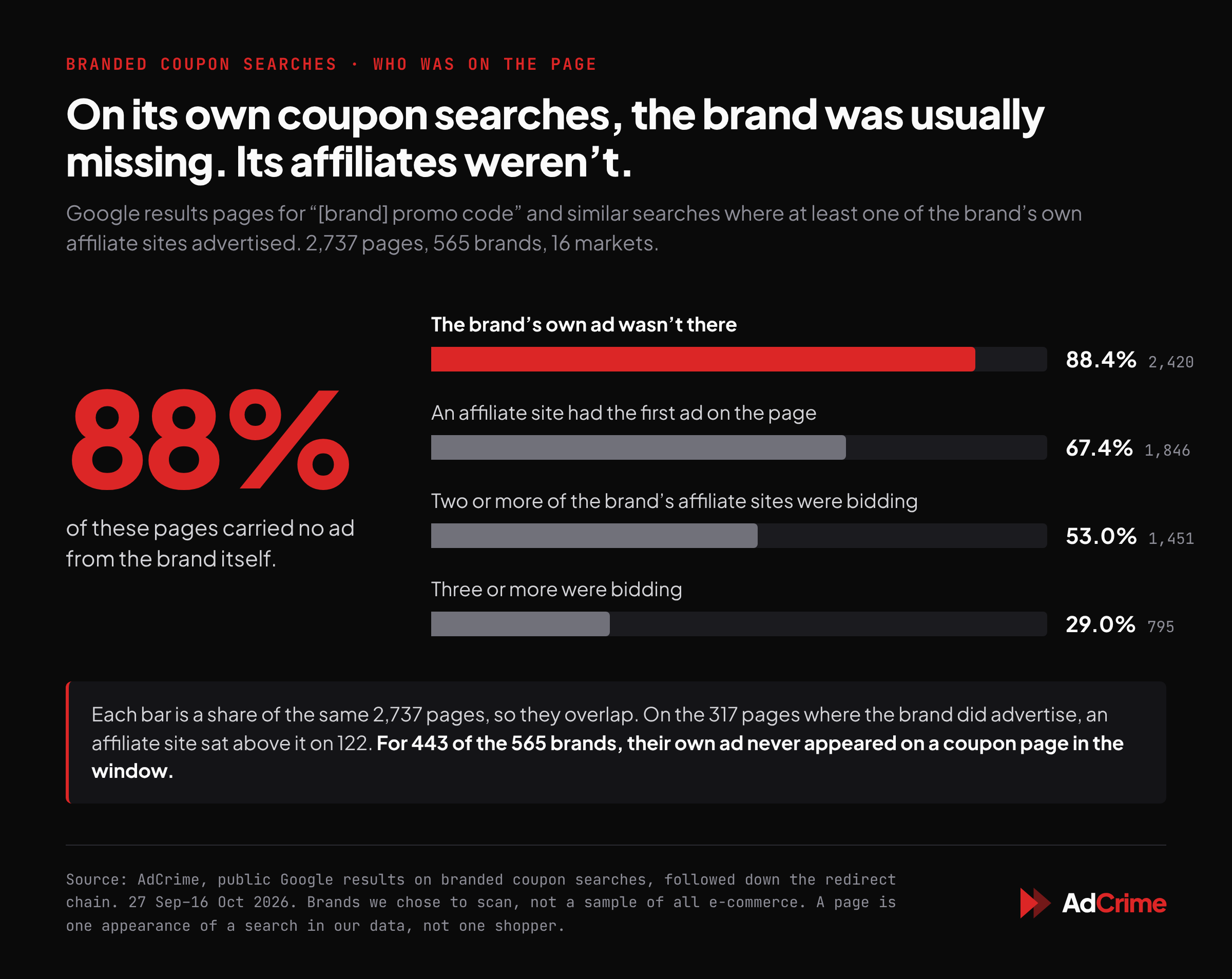
Most of that absence is brands not buying these searches at all, rather than being outbid. For 443 of the 565 brands, the brand's own ad didn't appear on any coupon results page in our data during the window. We can't see why. Some brands exclude coupon searches on purpose; some don't advertise in every market they sell in. Either way, the slot didn't stay empty.
Limits first. These are brands we chose to scan, often because we had already seen affiliates on them, so the shares are not rates for e-commerce. The window is three weeks, and the share moved within it, between 76% and 95% from one day to the next (on days with more than 50 of these pages). Fewer pages in our data carried ads in the last week, so most of these pages come from before 10 October. A results page is one appearance of a search in our data, not one shopper, and the same search usually appears on more than one page, so pages aren't independent. Affiliate sites are counted as domains, and two domains can belong to one operator. We identified the brand's own ads by the domain shown in the ad.
The longer record, which counts ads rather than pages, points the same way. Of 82,019 paid ads we captured on branded coupon searches between 19 February and 16 October, 42.7% sent the click through the brand's own affiliate program.
Should you bid on your own brand? Four studies
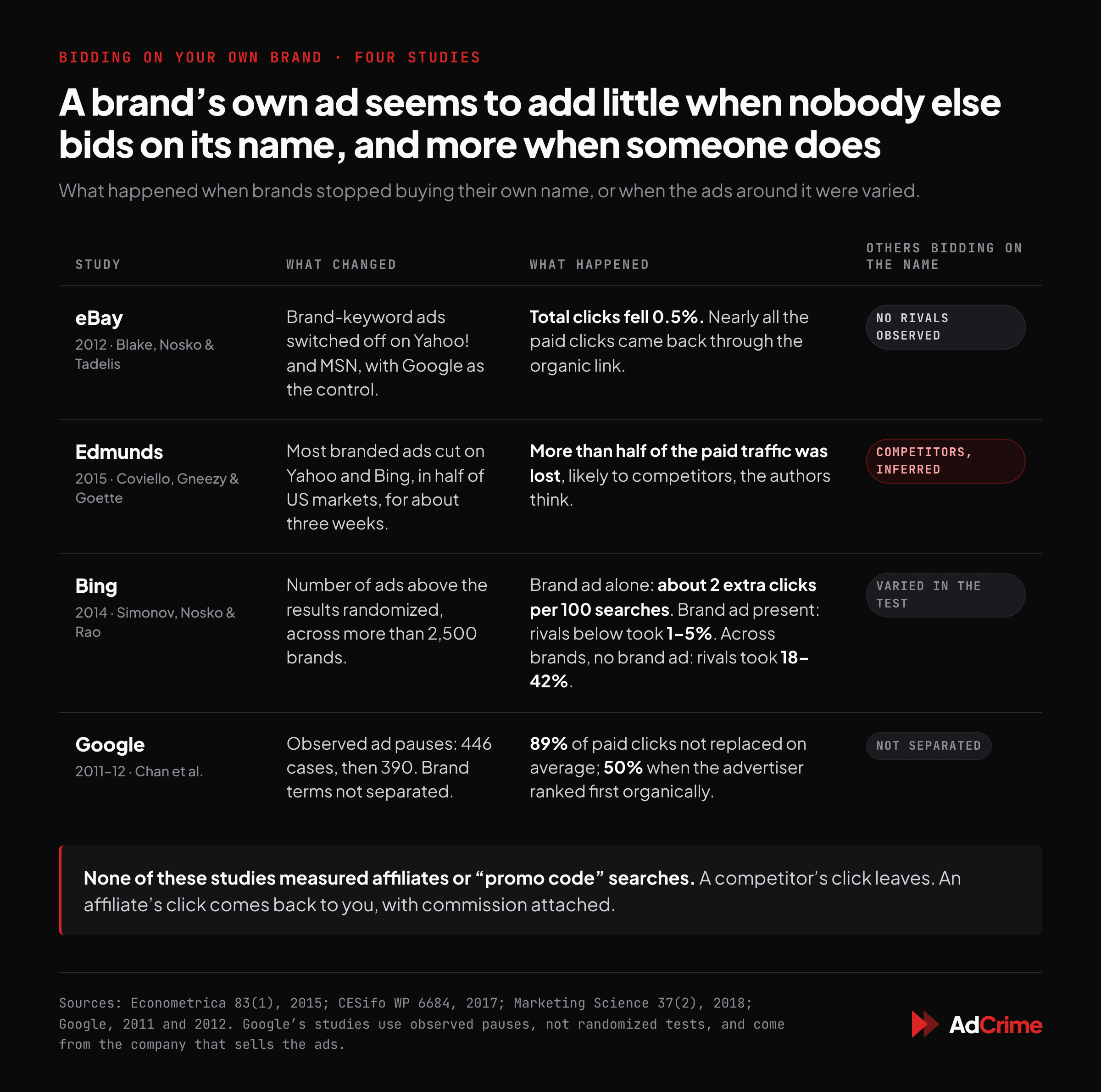
Four bodies of evidence come up whenever this gets argued. They seem to disagree, and the reason they disagree is the useful part.
eBay, 2012. eBay switched off its brand-keyword ads on Yahoo! and MSN, with Google as the control (Blake, Nosko & Tadelis, Econometrica, 2015). Once seasonality was accounted for, "only 0.529 percent of the click traffic is lost so 99.5 percent is retained". That is total clicks: by the authors' own footnote, the loss was about 1.5% of the paid clicks, so nearly all of them came back through the organic link. The authors conclude that "brand-keyword ads have no measurable short-term benefits." Two details matter here. After eBay stopped, competitor bidding on its name "was not observed". And the authors warn the result "may not be true for small and new entities that have no brand recognition."
Edmunds, 2015. The car-research site cut most of its branded search ads on Yahoo and Bing in half of US markets for about three weeks (Coviello, Gneezy & Goette, 2017). "More than half of the paid traffic is lost when we shut off paid-links search." The authors' explanation for the half that didn't come back: it "likely landed on the pages of Edmunds' competitors who happen to bid on the keyword 'Edmunds.'" They didn't observe the auction itself, and the loss varied widely from market to market.
Bing, 2014. A randomized experiment on Bing covering more than 2,500 brands (Simonov, Nosko & Rao, Marketing Science, 2018). With no competitors on the page, a brand's own ad brought "just over 2 extra clicks of 100 searches". With the brand's own ad present, competitors below it took 1%–5% of its clicks. And comparing across brands rather than by randomization, competitors took 18%–42% of the clicks from brands that faced them on their name and didn't advertise.
Google, 2011–2012. Google's analysis of 446 cases where advertisers paused their search ads found that, on average, 89% of paid clicks were not replaced by organic clicks (Chan et al., 2011). A follow-up on 390 cases put it at 50% when the advertiser already ranked first organically (Chan et al., 2012), which is where a brand usually sits on its own name. Both were based on observed pauses rather than randomized tests, neither separated brand keywords, and both come from the company that sells the ads.
Put together: a brand's own ad seems to add little when nobody else bids on its name, and more when someone does. eBay saw no rival move in on its name. The Edmunds authors think their lost traffic went to competitors bidding on "Edmunds", though they didn't observe it.
Coupon searches are where that gets awkward. On nearly half of the coupon results pages in our window that carried any ad, one of the bidders was an affiliate site in the brand's own program, and on most of those pages the brand itself was absent.
An affiliate isn't a competitor
Every study above measured competitors. A click a competitor takes is a visit that leaves. A click your affiliate takes isn't a lost visit: if the shopper clicks through, they land on your site, and any sale carries the affiliate's tracking.
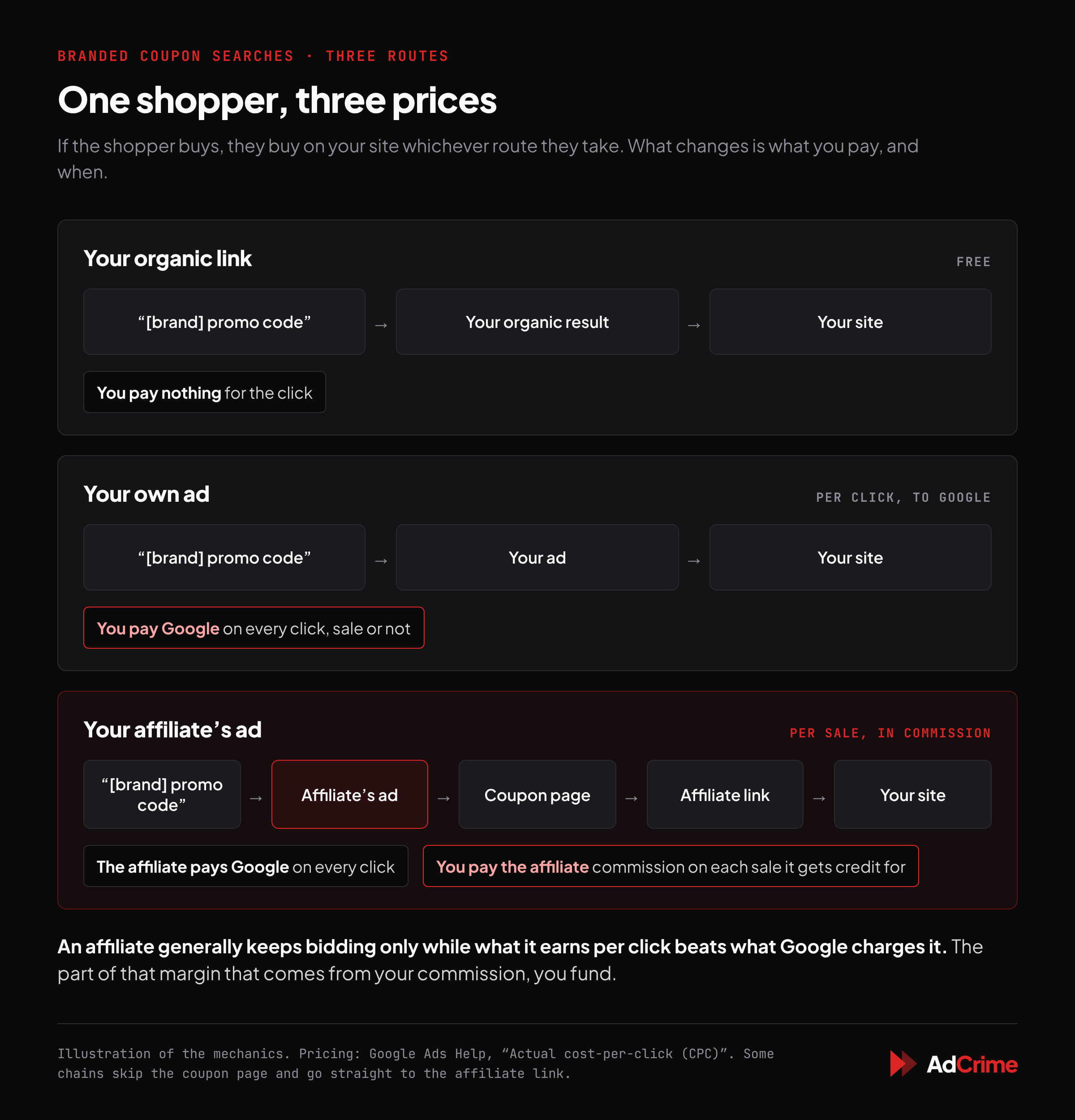
So the question isn't whether you lose the customer. It's what you pay for one you might have had anyway. That shopper can reach you three ways:
- Your organic link: free.
- Your own ad: Google's price, per click.
- Your affiliate's ad: Google charges the affiliate per click, and you pay commission on each sale it gets credit for.
For most brands in our data, the second route wasn't in play: they weren't buying the search. So the real comparison was the third against the first, a commissioned sale against a click that costs nothing.
Benjamin Edelman and Wesley Brandi studied affiliate abuse across the three largest US networks in 2012. On affiliates buying ads on a merchant's own name, they wrote (Journal of Marketing Research, 2015): "Sophisticated merchants largely disallow this practice because it tends to increase competition in the search engine advertising auction … and because merchants have found that they can buy these same keywords at prices lower than affiliate fees."
There's a reason to expect the second half to hold on your program too. The affiliate pays Google for every click and earns only when one converts, so it generally keeps bidding only while what it earns per click beats what Google charges it. An affiliate still on your coupon searches week after week is probably earning more from those clicks than they cost it. Coupon sites can earn on other offers and ads on the page too, so not all of that margin comes from you. The part that comes from your commission, you fund.
The auction on your name
On 53% of the pages that carried one of a brand's affiliate sites, two or more were in the same auction. Google describes how the price works: you pay "what's minimally required to clear the Ad Rank thresholds and beat the Ad Rank of the competitor immediately below you", and "if there are no competitors immediately below you … you only pay the reserve price" (Google Ads Help).
Two things follow. Each affiliate site's price is set by the bidder just below it, and the winner pays Google out of what your commission earns it. And if you start buying those searches yourself, the bidder ranked just below you sets your price, and that may well be one of your affiliates. With nobody below you, you'd pay the reserve.
The Bing study adds a quieter cost, measured on competitors rather than affiliates. When only the brand's own ad was on the page, about 60% of its traffic went through the paid link. With one, two and three competing advertisers, that rose to 70%, 78% and 84%: more of the brand's visits came through clicks it paid for. An affiliate in the same auction may push the same way.
None of this breaks Google's rules by itself. Google "will not restrict: Using trademarks as keywords" (Trademarks policy). What its Unfair advantage policy does list is "Affiliates that advertise on Google Ads against the applicable affiliate program rules". The rule has to be yours: how to write one, and what the law allows.
What affiliate brand bidding costs you: run your own numbers
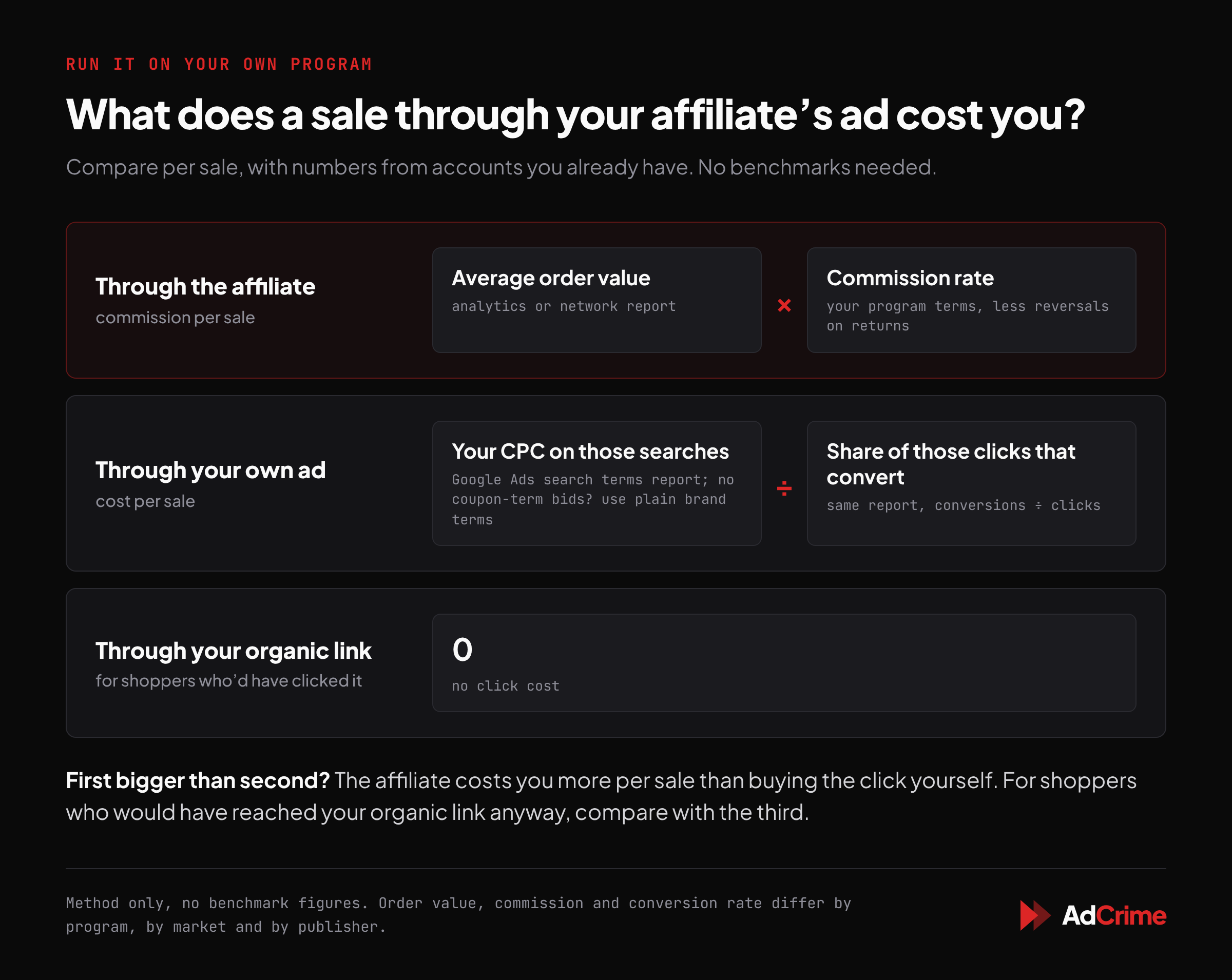
The comparison needs only your own accounts. Do it per sale.
A sale through the affiliate = average order value × commission rate, less the commission you reverse on returns.
A sale through your own ad = your CPC on those searches ÷ the share of those clicks that convert. If you don't bid on coupon terms, your plain brand terms are the nearest guide.
A sale through your organic link = nothing, for the shoppers who would have clicked it.
If the first number is bigger than the second, the affiliate costs you more per sale than buying the click yourself would. And for the shoppers who would have reached your organic link anyway, the comparison is with the third. The brand-keyword experiments above are the best guide to how many that is.
What the research can't tell you
- We found no peer-reviewed experiment on coupon searches or affiliates. The Bing study used navigational brand-name searches. eBay and Edmunds used any search containing the brand but didn't break out "promo code" searches, and the other bidders were competitors.
- Most of it measures clicks, not sales. A shopper hunting for a code may not buy without one. We found no published test of that for coupon searches.
- Your organic result may not be first. If the organic results for your coupon searches are coupon sites in your program, some of those sales carry commission either way. Look at your own page before assuming the alternative is free.
- The only controlled affiliate on/off test we found is a vendor case study. A direct-to-consumer brand switched off its cash-back and loyalty partners in the US for seven weeks, and "the analysis revealed no change in revenue between the US & comparable regions" (Haus, 2023). One unnamed brand, no effect sizes published, and loyalty sites rather than coupon sites.
- Our pages cover three weeks and brands we chose. Treat them as a signal, not a census.
Without buying anything
- Search your coupon terms ("[brand] promo code", "[brand] discount code", "[brand] voucher") in each market you sell in, at more than one time of day. Note whose ads appear and whether yours is one of them.
- Check your negative keywords. If "coupon", "promo code" or "voucher" is on the list, your affiliates may have those searches to themselves.
- Follow each affiliate ad down the redirect chain to the network and publisher ID.
- Run the per-sale comparison above for each publisher you find.
- Write the rule down, naming the coupon words (template).
- Act inside the validation window, and file against the publisher account, not only the domain.
- Then test it. For your own ads, do what Edmunds did: switch your coupon-term ads off in half your regions for a few weeks and compare sales, not clicks. For the affiliates, pause a group of publishers in one market and compare it with markets where they stay on.
If you'd rather start from your own data, the first scan is free.
Mario Vaher is the founder of AdCrime, which traces paid ads on branded coupon searches (public Google results, followed down the redirect chain) to the network and publisher account behind each one.