
A brand-bidding policy holds up when an affiliate who breaks it has nothing left to argue about. A policy can be sincere and still fail on drafting. "No PPC on our brand" doesn't say whether "[brand] promo code" counts, whether misspellings count, whether a broad match campaign that wandered onto your name counts, or what happens to the commission. Each gap becomes a dispute you have to win later, while the network's reversal window runs out.
The fix is a clause that names each case, says how you will prove a breach, and ties the penalty to the person behind the account. Below: the twelve elements and why each matters, the full clause to copy, how it fits each network's reversal window, and how to roll it out.
I run AdCrime, and we sell the monitoring that catches affiliates breaking clauses like this one, so weigh the argument accordingly. Network rules come from each network's own help pages, checked on 9 October 2026; the numbers on branded coupon searches come from our scans.
Why the one-line rule fails
Google won't fill the gaps for you. Its trademark policy says it will not restrict "Using trademarks as keywords", and its exceptions for resellers and informational sites may cover a coupon page that uses your name in ad text. What Google does recognize is your rulebook: its Unfair advantage policy lists "Affiliates that advertise on Google Ads against the applicable affiliate program rules" as a violation. That only helps if your rules clearly show a breach.
The vague cases are also the common ones. In public Google results we captured from 19 February to 25 September 2026, 43% of the 71,482 paid ads on branded coupon searches sent the click through the brand's own affiliate program. The brands are ones we chose to scan, not a sample of all e-commerce.
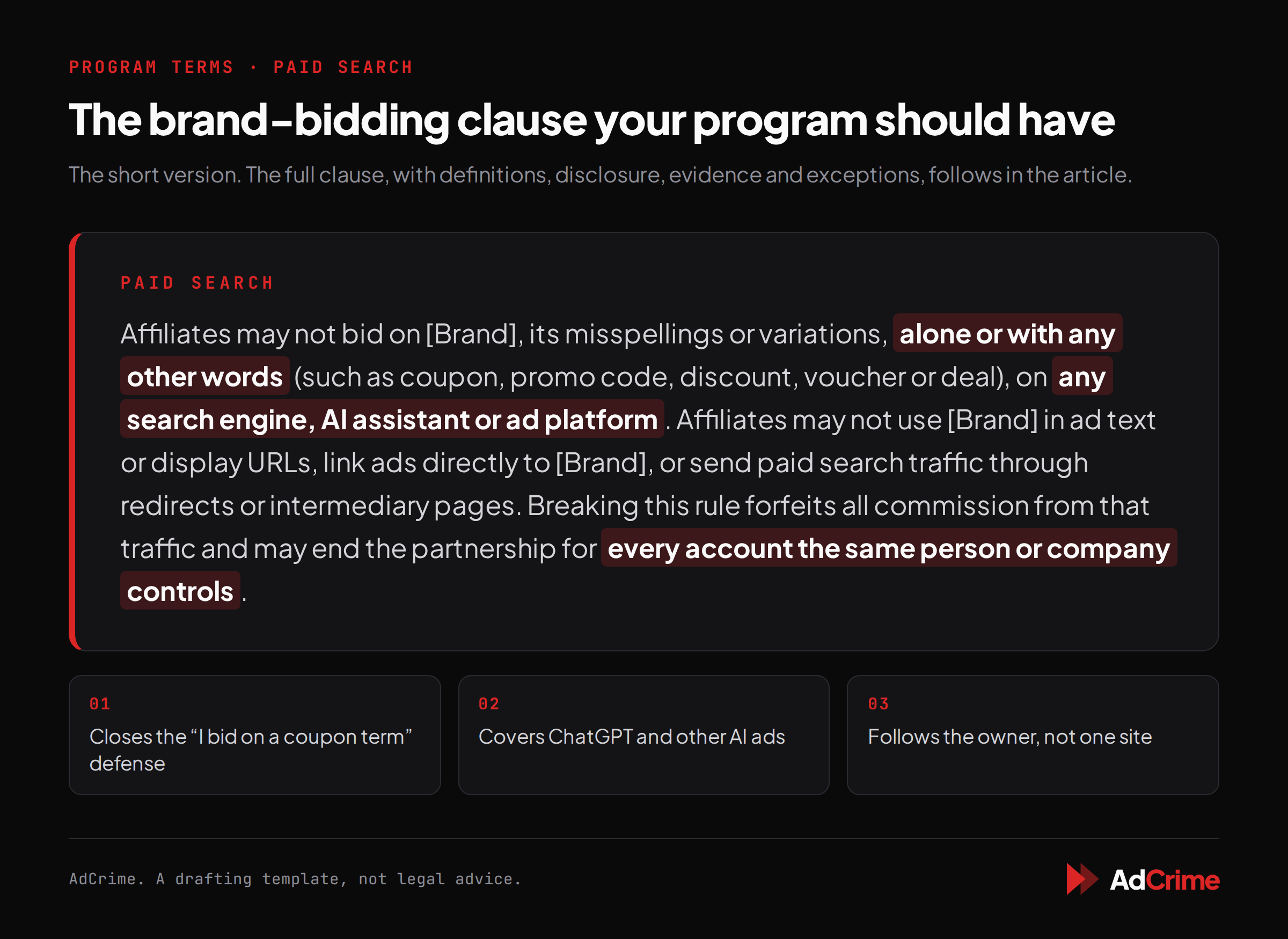
That's the short version I posted on LinkedIn. Here is what each part does, and what it leaves out.
The twelve things the clause has to cover
- Define brand terms widely. Include [Brand], your other trademarks, product names and domains, and every misspelling, variation, abbreviation and translation. Monitoring takes you literally: impact.com's Paid Search Monitoring matches exactly, and "Any variations or misspellings must be entered as separate keywords" (impact.com). Your contract should be at least that wide.
- Cover your brand with any other word. "Alone or with any other words" is the most important phrase in the clause. Naming coupon, promo code, discount, voucher and deal removes the "I bid on a coupon term" defense. One program on Awin writes: "This includes permutations, misspellings and broad matches containing brand terms" (Awin).
- Require negative keywords. Broad match, Performance Max and AI Max pick queries for the advertiser, so "I never bid on it" can be true. Another Awin program says it in one line: "Brand terms must be added as negative keywords across all PPC campaigns" (Awin). Google's brand exclusions for Performance Max and Search campaigns "keep your campaigns from serving for branded queries you want to avoid." Make the affiliate responsible for every query its campaigns match.
- Ban your name in the ad, not only the bid. An affiliate can bid on "running shoe deals" and still put your brand in the headline or display URL, so ad text needs its own rule.
- Ban direct linking and the redirects that copy it. A direct-linked ad sends the click straight to your site through a tracking link, so it looks like your own ad and still earns commission. The workaround is a bridge page or redirect that forwards the click automatically. ShipBob's affiliate terms close both: no direct linking from a PPC ad, and no "redirects that yield the same result." The redirect chain guide shows how to follow one.
- Name every platform, including AI assistants. "Search engines" is out of date. ChatGPT ads aren't bought on keywords: advertisers describe their business in "context hints", and OpenAI matches ads to the conversation. Cover ads in or next to AI-generated answers, and any targeting, prompt or context description that names [Brand]. Can affiliates run ChatGPT ads on your brand? explains the gap.
- Carve paid ads out of your trademark license. OpenAI's ad policy lets advertisers use trademarks "they own or are authorized to use" and doesn't address affiliate marketing. A broad affiliate license can be read as that authorization. ShipBob's terms do both jobs: they grant "a limited, non-exclusive, revocable, royalty-free right to use the Trademarks" in connection with the program, and still ban bidding on them "on Google, MSN, Facebook, Yahoo or any other network". Add one sentence excluding paid advertising from the license unless approved in writing.
- Make affiliates answer for their sub-affiliates. When a subnetwork's sub-publisher bids, the subnetwork says it wasn't them. Make the affiliate you contract with responsible for anyone it passes your offer to, require it to name them on request, and apply the same rules. Some programs, ShipBob's among them, ban subcontracting and sublicensing outright. More in the subnetworks piece.
- Require disclosure on request. You can't see inside an affiliate's ad accounts, and OpenAI publishes no official ad archive for ChatGPT. Require ad accounts, keyword and negative lists, context descriptions and destination URLs within a set number of days, and make silence a breach.
- Say what counts as evidence. Disputes are often about proof: not us, wrong country, old screenshot. Name what you will rely on: a screenshot showing date, time, market and query, plus the redirect chain from the ad to your site with the affiliate's tracking ID.
- Put exceptions in writing. If some partners may bid on your brand plus a modifier (often called TM+), the approval should name the account, keywords, platforms, markets, ad copy and an end date, and come from one address you control. An informal OK from a former account manager is hard to disprove later.
- Make the consequence specific, and tie it to the owner. "All commission from that traffic" is hard to apply, because nobody can say which sale came from the ad. Forfeit all commission the account referred during the breach period, and add a route to recover commission that has already locked. Of the 488 affiliate network accounts we identified by publisher ID in the same scans, 84% sat behind one site, but the widest sat behind 32. Remove a site and the account carries on; remove an account and the owner can return under another. The penalty should cover every account the same person or company controls.
The full clause to copy
Paste this into the paid search section of your program terms and replace everything in brackets. It is numbered as section 7; renumber to fit.
7. Paid search and paid placements
7.1 Definitions. "Brand Terms" means [Brand], [Brand]'s other trademarks, product names and domain names, and any misspelling, variation, abbreviation, translation or close derivative of them, with or without spaces or punctuation. "Paid Placement" means any ad, sponsored listing or sponsored result bought on a search engine, AI assistant or ad platform, including ads shown in or next to AI-generated answers, such as ChatGPT ads. This section applies in every market and language.
7.2 Bidding. The affiliate may not bid on Brand Terms, alone or with any other words (such as coupon, promo code, discount, voucher, code, sale or deal), in any match type, on any search engine, AI assistant or ad platform. This includes any targeting, prompt, audience or context description that names [Brand] or a Brand Term.
7.3 Negative keywords. The affiliate must add Brand Terms as negative keywords, or use the platform's equivalent such as brand exclusions, in every paid search campaign, including broad match, Performance Max and AI Max campaigns, wherever the platform allows it. The affiliate is responsible for every query its campaigns match, whether or not it chose the keyword.
7.4 Ads and destinations. The affiliate may not use Brand Terms in ad text, headlines, display URLs, sitelinks or advertiser names. It may not link a Paid Placement directly to a [Brand] website, or send Paid Placement traffic through redirects, tracking links, bridge pages or other intermediary pages that forward it automatically to a [Brand] website.
7.5 Trademark license. The license to use [Brand]'s trademarks in section [X] does not cover Paid Placements, ad text, display URLs or ad account names, unless [Brand] approves that use in writing under 7.8.
7.6 Sub-affiliates and subnetworks. If the affiliate makes [Brand]'s offers available to sub-affiliates, sub-publishers or a subnetwork, it must apply this section to them, is responsible for their breaches as if they were its own, and must identify any of them within [5] business days of [Brand]'s request.
7.7 Disclosure. Within [5] business days of [Brand]'s request, the affiliate must provide: (a) the names and IDs of its ad accounts on any platform; (b) its keyword and negative keyword lists, and any targeting, prompt or context descriptions; and (c) the destination URLs and tracking templates of its Paid Placements. Failure to provide them in time is a breach of this section.
7.8 Exceptions. Any exception, including bidding on Brand Terms with other words, needs [Brand]'s prior written approval sent from [approved email address]. The approval must name the affiliate account, keywords, platforms, markets, ad copy, landing pages and end date. It covers only what it names, and [Brand] may withdraw it at any time by written notice.
7.9 Evidence. [Brand] may rely on screenshots or recordings showing the date and time, the market or location, the search query or prompt, the ad, and the redirect chain from the ad to [Brand]'s website, including the affiliate's tracking ID. These records are sufficient evidence of a breach unless the affiliate proves otherwise.
7.10 Consequences. If the affiliate breaches this section: (a) all commission on transactions it referred during the breach period is forfeited, and [Brand] may decline or reverse it within the network's validation or reversal window; (b) [Brand] may recover commission already locked or paid by deducting it from future commissions [or by invoice]; and (c) [Brand] may remove the affiliate from the program with or without notice. These remedies apply to every account controlled by the same person or company. The breach period runs from the earliest date [Brand] has evidence of the breach until the breach stops.
This is a drafting template, not legal advice. Have a lawyer check it against the rest of your agreement and the law where you operate.
Match the clause to your network
The clause only pays out if you act before the transaction locks. When the window closes, Awin auto-approves the transaction, and impact.com and CJ lock it.
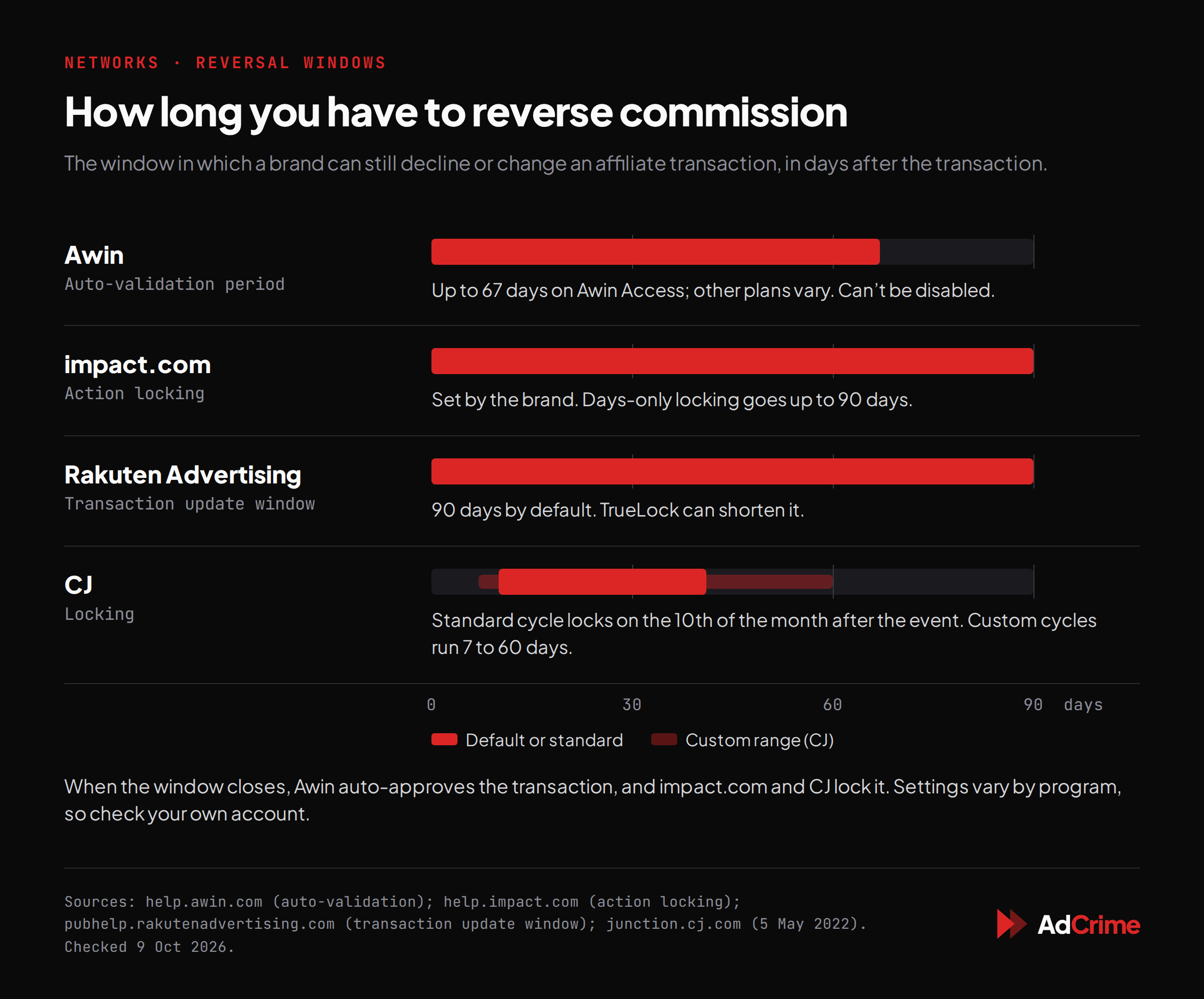
- Awin. The PPC policy is a free-text section in each program's terms, next to sections such as "Programme Restrictions", "Discount codes" and "Validation Policy" (example). Paste the full clause there. On the auto-validation period, Awin says "It's not possible to disable the AVP" and recommends your returns period "plus an extra seven days". Awin Access allows up to 67 days; other plans depend on sector and contract (Awin).
- impact.com. Days-only action locking has a maximum of 90 days, and "the action can't be updated once this period has passed" (impact.com). Enter each misspelling and coupon combination as its own monitored keyword.
- Rakuten Advertising. "By default, the transaction update window is 90 days." Advertisers can shorten it with TrueLock (Rakuten Advertising), which also shortens your time to act.
- CJ. The clearest public description is CJ's 2022 Junction blog: under the standard cycle, transactions lock on the 10th of the month after the event date, and custom cycles run 7 to 60 days (CJ). Check your current setting.
- Webgains. The keyword policy setting is Open, Restricted or Closed. Under Restricted, publishers "may not bid on specified keywords, including brand names, misspellings, and restricted terms" (Webgains). Pick it, list the terms, and keep the full clause in your terms.
A window that only matches your returns period leaves little time to investigate a case found late. The validation window piece covers how to size it.
How to roll it out
- Set an effective date and give notice. Update the terms on each network and message every affiliate with the new section and its start date. Check how much notice your agreement and network require.
- Get written acknowledgment from every affiliate that runs paid media, every subnetwork and your top partners by revenue. Keep the reply or in-platform acceptance with the account record.
- Align your monitoring. Load the same brand terms, misspellings and coupon combinations into whatever monitoring you use.
- Take a baseline of who bids on your branded coupon searches the week before the effective date. It shows who needs a direct conversation.
- Keep dated evidence for every case: screenshot, date, time, market, query, redirect chain, affiliate ID and network, stored where your team can find it. The enforcement workflow covers what comes next.
- Enforce the first breach as written. A quiet exception for a big partner becomes the precedent the next one cites.
If you want to know which affiliates are bidding on your branded coupon searches in Google right now, the first scan is free.
Mario Vaher is the founder of AdCrime, which traces paid ads on branded coupon searches (public Google results, followed down the redirect chain) to the network and publisher account behind each one.