
Short answer: nothing in OpenAI's published rules stops them. OpenAI's ad policy doesn't address affiliate marketing, coupon sites or ads that appear when someone asks about another company's brand. Your program terms may not name AI assistants either. And unlike a Google ad on "[brand] promo code", a ChatGPT ad is hard to see from the outside.
This piece covers what ChatGPT ads are in October 2026, who is buying them, what OpenAI's rules do and don't say, and the lines to add to your program terms now.
I run AdCrime. We track paid ads on branded coupon searches in Google. We don't monitor ChatGPT ads yet, so everything below comes from OpenAI's own pages and published studies, not from our data. Weigh it accordingly.
ChatGPT ads went from test to Europe in seven months
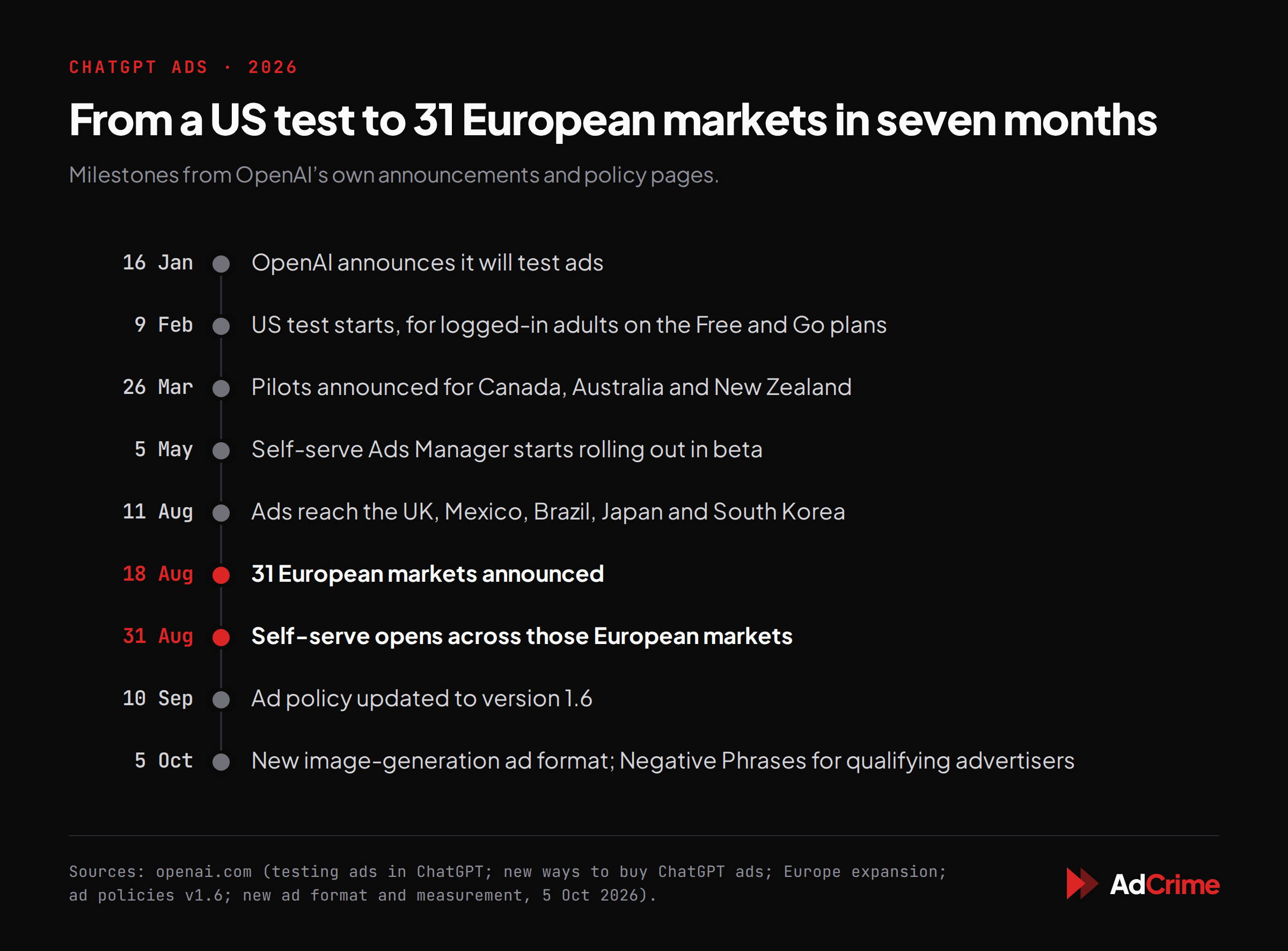
OpenAI said in January that it would start testing ads. The US test began on 9 February 2026, shown to logged-in adults on the Free and Go plans. In May OpenAI began rolling out a self-serve Ads Manager in beta, alongside its sales team and agency partners. In August the ads reached the UK, Mexico, Brazil, Japan and South Korea, and on 18 August OpenAI announced 31 European markets. Self-serve opened across those markets on 31 August.
How the ads show up, per OpenAI's help center:
- Ads appear below the end of an answer. There can be "one or more ad units below a ChatGPT response", and one unit can carry items from several advertisers.
- Free, Go and logged-out users can see them. Plus, Pro, Business, Enterprise and Edu accounts don't.
- No ads for accounts identified as under 18, none in Temporary Chats, and none next to sensitive or regulated topics.
- Which ad you see depends on "the context and intent of your current conversation", on relevance and advertiser bids, and, if personalization is on, on past chats and memory.
That matters for affiliate managers, because advertisers don't buy keywords. They describe their business in "context hints", which OpenAI defines as "additional details about your business, product, or service". Its example for a running-shoe brand is "Cushioned everyday running shoes for beginners training for their first 5K". OpenAI tells advertisers to write "a clear, natural phrase focused on one idea rather than a list of disconnected keywords", and says "Hints are not targeting rules or delivery instructions."
So "can an affiliate bid on my brand in ChatGPT?" doesn't map neatly onto how the product works. An affiliate doesn't need your brand in a keyword list. A coupon site whose hint describes discount codes for running gear could, for all we know, be matched to a conversation about your promo codes. OpenAI's help pages don't say whether a hint that names another company's brand is accepted, limited or refused.
Who is buying the ad slots
Three studies measured how often ChatGPT answers carried ads this summer. Their prompt sets and methods differ, so the rates aren't comparable with each other.
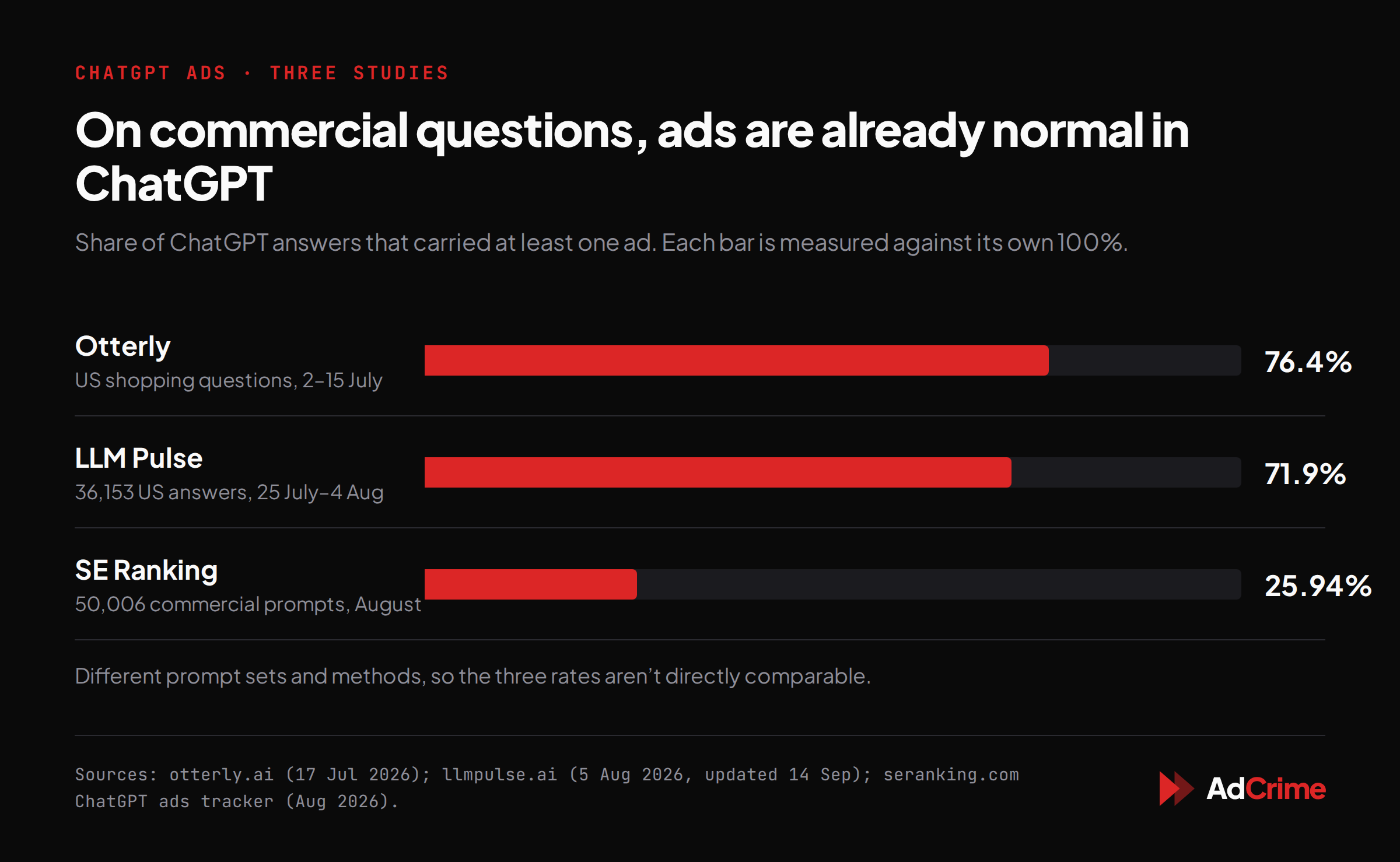
- Otterly (US, 2 to 15 July 2026): "76.4% of the time, asking ChatGPT a shopping question returns an answer with an ad in it."
- LLM Pulse (36,153 US answers, 25 July to 4 August 2026): 71.9% carried at least one ad, from 3,033 advertisers.
- SE Ranking (50,006 commercial prompts across 20 niches, August 2026): ads on 25.94% of prompts, from 1,159 different advertisers.
Two of them looked at who the advertisers are, and saw the same pattern. Otterly found that in most categories the brands winning the ad slots "are affiliate marketplaces, comparison sites, and lead-generation platforms built to buy performance media." LLM Pulse put it more bluntly: "Comparison and affiliate sites are bidding against the brands they review."
LLM Pulse also isolated the case that should worry you most: answers to prompts that name a brand. Of 2,611 such answers that carried an ad, 45 showed the named brand's own ad. Another 133 showed an ad from a direct competitor the study tracked. The other 2,433, or 93.2%, showed an ad from some other advertiser.
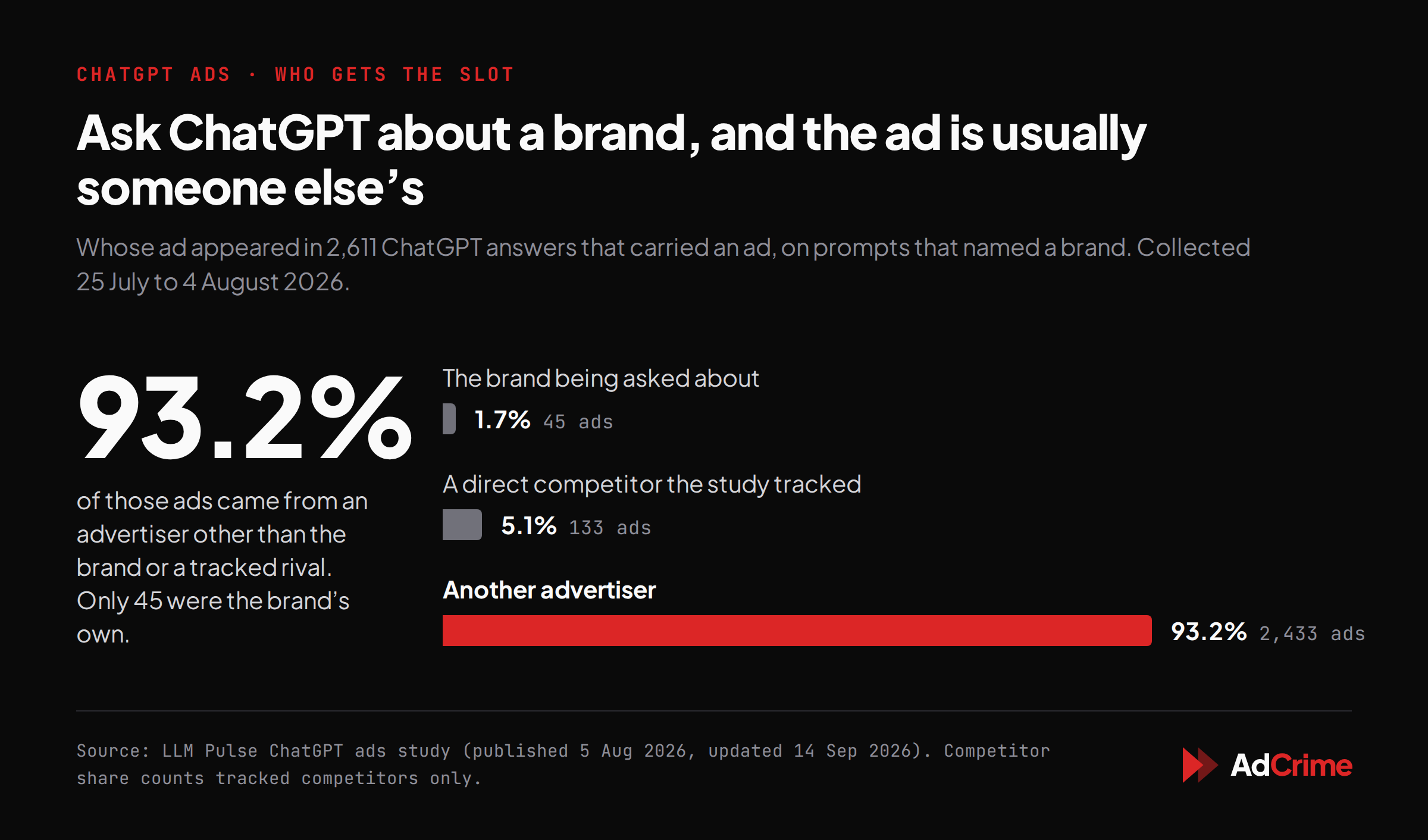
That third group is where an affiliate would sit: not you, not a tracked rival, but possibly someone who earns when the customer buys from you. The study doesn't break those 2,433 ads down, so it doesn't say how many came from the named brand's own affiliates. You can check part of it yourself. LLM Pulse now runs a ChatGPT ads library, searchable by advertiser once you sign in, and you can compare the advertisers in your category with your partner list. It only covers the prompts LLM Pulse samples.
Coupon sites haven't shown up as a named group in these studies yet. They may not need ads to reach ChatGPT users. Coupons.com tested the discount codes ChatGPT, Gemini and Claude suggested for 101 US retailers on 4 to 7 August. Only 24.5% of the codes it could test worked, and 46% couldn't be tested at all. Coupons.com argues the assistants pull codes from coupon pages. It's Coupons.com's own study, and it promotes its own codes.
What OpenAI's rules say, and what they don't
OpenAI's ad policy is on version 1.6, updated 10 September 2026. Four lines in it touch this problem:
- Advertisers "may use only the trademarks, logos, brand assets, and other intellectual property they own or are authorized to use."
- Advertisers "may not impersonate another business or create a misleading impression of endorsement, sponsorship, or affiliation."
- Under "Truthful identity and affiliation", advertisers "may not misrepresent their relationship with another individual, organization, or brand".
- "Ads must lead users to destinations that clearly relate to the advertiser and the offer being promoted."
The middle two help against an affiliate whose ad suggests it is you, or officially connected to you. None of the four says an advertiser can't appear in conversations about someone else's brand. The policy doesn't mention affiliate marketing, and the words coupon, competitor, keyword, redirect and cloaking don't appear in it.
The separate Advertising Terms (updated 25 August 2026) define an ad's destinations as including "URLs, redirects, and waypoints". OpenAI hasn't said how the destination rule applies to an ad that passes through an affiliate tracking link to another company's site. The advertiser warrants that its campaigns don't violate any third party's rights, but the terms set out no complaint procedure for a brand that thinks otherwise.
We found no ad-specific trademark complaint route in OpenAI's ads help center. OpenAI's trademark and counterfeit form covers material hosted on its platform, such as GPTs, and links shown in ChatGPT search. It doesn't mention ads. The one ad tool in the product is "Report ad", which hides the ad for that user and sends it for review.
On 5 October OpenAI announced a new image-generation ad format and made "Negative Phrases" available to qualifying advertisers "for narrow placement requirements specific to a brand's own policies". It didn't say more. Our reading is that they let an advertiser keep its own ads away from chosen phrases. Nothing in the announcement lets a brand keep someone else's ad away from its name.
Your own affiliate agreement may be the authorization
Read the trademark line again: advertisers may use marks they "own or are authorized to use". Many affiliate agreements grant a trademark license. ShipBob's, for example, gives affiliates "a limited, non-exclusive, revocable, royalty-free right to use the Trademarks" in connection with the program. ShipBob pairs it with a wide ban: no bidding on its trademarks "for search or content-based campaigns on Google, MSN, Facebook, Yahoo or any other network".
That's the right shape. If your agreement licenses your name but limits the bidding ban to "search engines", or has no ban at all, an affiliate running ChatGPT ads can argue it is inside the license. Close that gap in your terms. OpenAI won't do it for you.
Why you probably wouldn't notice
With Google, you can at least go and look. You can search your own brand, see who bids, look an advertiser up in Google's Ads Transparency Center, and file a trademark complaint about ad text. ChatGPT gives you much less.
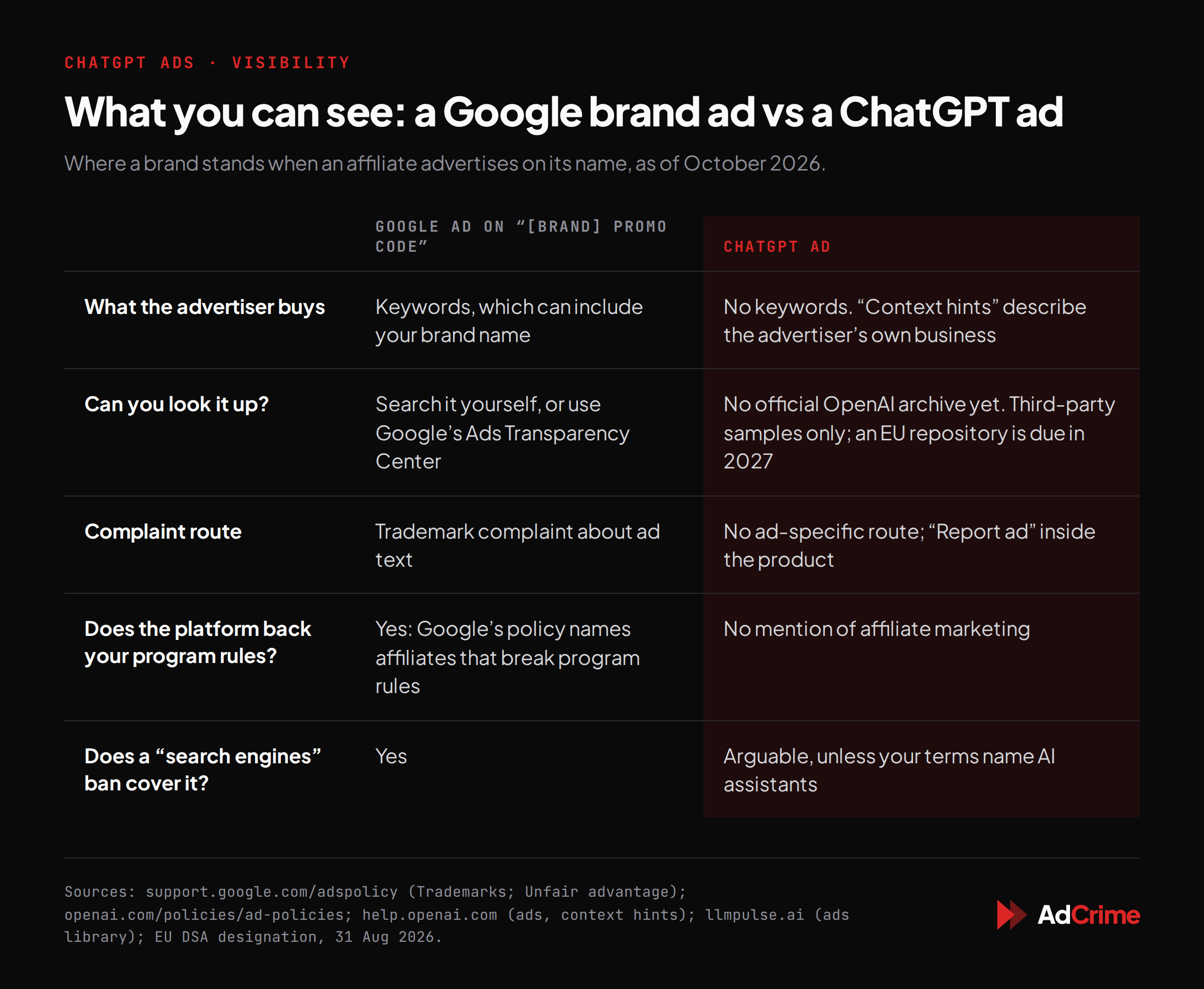
- No brand keyword to check. Ads are matched to conversations, not bought on terms, so there's no list of who bought your name.
- No official ad archive yet. OpenAI doesn't publish a searchable archive of ChatGPT ads. Third-party libraries, such as LLM Pulse's, only show what their own prompts turned up. That may change in Europe: on 31 August the European Commission designated ChatGPT a very large online search engine under the Digital Services Act. Very large services that show ads must keep a public ad repository, and the new obligations apply from January 2027.
- Advertisers see their own numbers. OpenAI's reporting covers an advertiser's own views, clicks and conversions. We found nothing in its documentation that shows anyone who else appeared on a topic.
- What you see isn't what your customer sees. Ads depend on the conversation and, with personalization on, on past chats and memory. One spot check from your own account proves little either way.
The click trail is also thin. OpenAI's conversion-tracking documentation says: "When an ad click supplies an oppref identifier, capture it". According to the tracking vendor AnyTrack, OpenAI "appends the parameter oppref to every landing page URL" and adds no UTM parameters of its own.
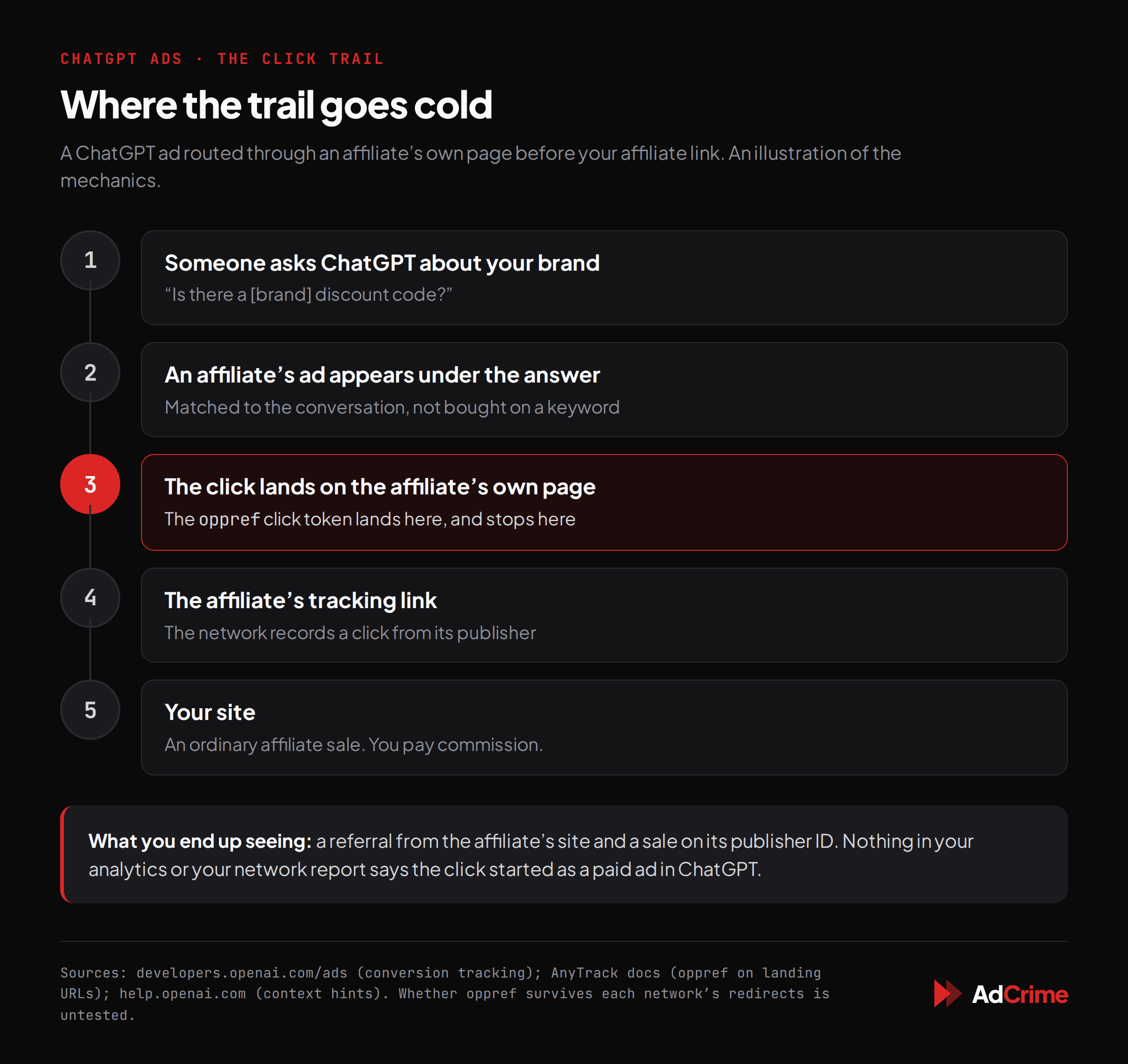
As far as we can tell, the oppref value lands on whatever page the ad points to. If an affiliate points its ad at its own review or coupon page, that's where the token stops. By the time the visitor reaches you through the affiliate's tracking link, your analytics shows a referral from the affiliate's site and your network shows an ordinary affiliate sale. Nothing in either says the click started as a paid ad in ChatGPT.
If the ad points straight at the tracking link, the token may sit on that first hop, where only the network's raw click data could show it. Whether it survives each network's redirects is untested.
Google's AI answers are a different case
Ads around Google's AI Overviews come from ordinary Google Ads campaigns. Google says ads can show above or below AI Overviews in every market where they run, and that "Text and Shopping ads from existing Search, Shopping and Performance Max campaigns" are eligible to show within them. Ads within AI Overviews are so far limited to English in a list of countries that includes the US, and Google keeps them out of sensitive categories such as finance and healthcare.
So an affiliate already bidding on your brand in Google may reach those placements without changing anything, and the paid-search rules you already have cover it. Google's own policy backs those rules: its Unfair advantage policy lists "Affiliates that advertise on Google Ads against the applicable affiliate program rules".
Microsoft is similar: it says its Performance Max campaigns can reach Copilot. Again, these are ordinary Microsoft Advertising campaigns.
ChatGPT is the exception. It's a separate ad platform with its own accounts and no keywords, and terms written for search engines may not reach it. That's the gap.
What to put in your program terms now
You can't police an ad platform you can't see into. You can make the rule explicit, so that when one of these ads does surface, through a screenshot, a customer, or a network's click data, the commission question is already settled.
1. Name AI assistants in the paid-search ban. "Search engines" is no longer enough. Copy and adapt:
Paid placements. Affiliates may not bid on [Brand], its misspellings or variations, alone or with any other words (such as coupon, promo code, discount, voucher or deal), on any search engine, AI assistant or ad platform. This includes ads that appear in or alongside AI-generated answers, such as ChatGPT ads, and any targeting, prompt or context description that names [Brand].
2. Carve paid placements out of the trademark license. Add one sentence to the license clause: the right to use [Brand]'s marks does not extend to paid advertising on any platform, including AI assistants, without written approval.
3. Require disclosure. Affiliates that run ads on any AI assistant must tell you, and on request share the context hints, the advertiser account name and the destination URLs.
4. State the consequence, and tie it to the person. Commissions from traffic that breaks the rule are forfeited, and the partnership can end for every account the same person or company controls. The subnetworks piece explains why the account level matters.
Then a few practical checks:
- Ask your affiliate network whether it can show you the raw click or landing URLs for a partner, and look for
oppref. If the answer is no, you have learned something too. - Look for yourself, more than once. Use a logged-out browser and ask what your customers ask: "[brand] discount code", "is [brand] worth it", "[brand] alternatives". If a sponsored unit appears, screenshot it with the date, follow where it goes, and use "Report ad".
- Check the third-party libraries for advertisers in your category, and compare them with your partner list.
- Keep your Google rules tight. AI Overviews ads come from the same campaigns your current paid-search rules already cover. The enforcement workflow still applies, and so does reading the redirect chain.
OpenAI could add a trademark rule or an ad complaint form at any point, and the EU rules may force an ad repository next year. Until then, your program terms are the only rule written for an affiliate's ChatGPT ads.
We watch Google today. If you want to know who is bidding on your brand there, the first scan is free.
Mario Vaher is the founder of AdCrime, which traces paid ads on branded coupon searches (public Google results, followed down the redirect chain) to the network and publisher account behind each one.