
If an affiliate bids on "[your brand] promo code" on Black Friday and gets credited with the sale, the window to decline that commission can close within two weeks.
Black Friday is Friday 27 November 2026. On CJ's standard cycle, that sale's commission locks on 10 December, 13 days later. PartnerStack charges November's invoice at the end of 7 December. Under impact.com's recommended default and Webgains' default, it's 27 December. Others run into January or February. After the lock, most networks' own pages say the commission can't be reversed.
The declines happen in December. Everything that makes them possible happens before Black Friday: knowing your lock dates, having the rule in your program terms, and knowing which accounts are bidding. Below are the dates for eight networks, what you can still do after each one, and a dated plan from now to January.
I run AdCrime, and we sell monitoring of these searches, so weigh the argument on its evidence. The dates come from each network's own pages, and everything in the plan works without us.
The lock dates, network by network
Each network runs some version of the same clock: a commission is pending, then it locks or is approved, then it's paid. While it's pending, you can decline it.
Here is when a commission from a Black Friday sale locks, under each network's published default where there is one.
| Network | Published rule | Black Friday sale (27 Nov) | Cyber Monday sale (30 Nov) |
|---|---|---|---|
| PartnerStack | Monthly invoice, 7 days to review, then charged | 7 Dec | 7 Dec |
| CJ | Standard cycle: 10th of the month after the event | 10 Dec | 10 Dec |
| Tradedoubler | Auto-approval by tier: 15, 30 or 60 days (Run up to 90) | 12 Dec, 27 Dec, or 26 Jan to 25 Feb | 15 Dec, 30 Dec, or 29 Jan to 28 Feb |
| impact.com | Recommended default: 27 days after the end of the month | 27 Dec | 27 Dec |
| Webgains | Validation period, 30 days by default | 27 Dec | 30 Dec |
| Rakuten | 45 days under its May 2026 payment terms | 11 Jan | 14 Jan |
| Awin | Set per program; up to 67 days on Awin Access | Depends; 2 Feb at 67 days | Depends; 5 Feb at 67 days |
| Partnerize | Contractual "Force Approval Period"; no public default | Depends | Depends |
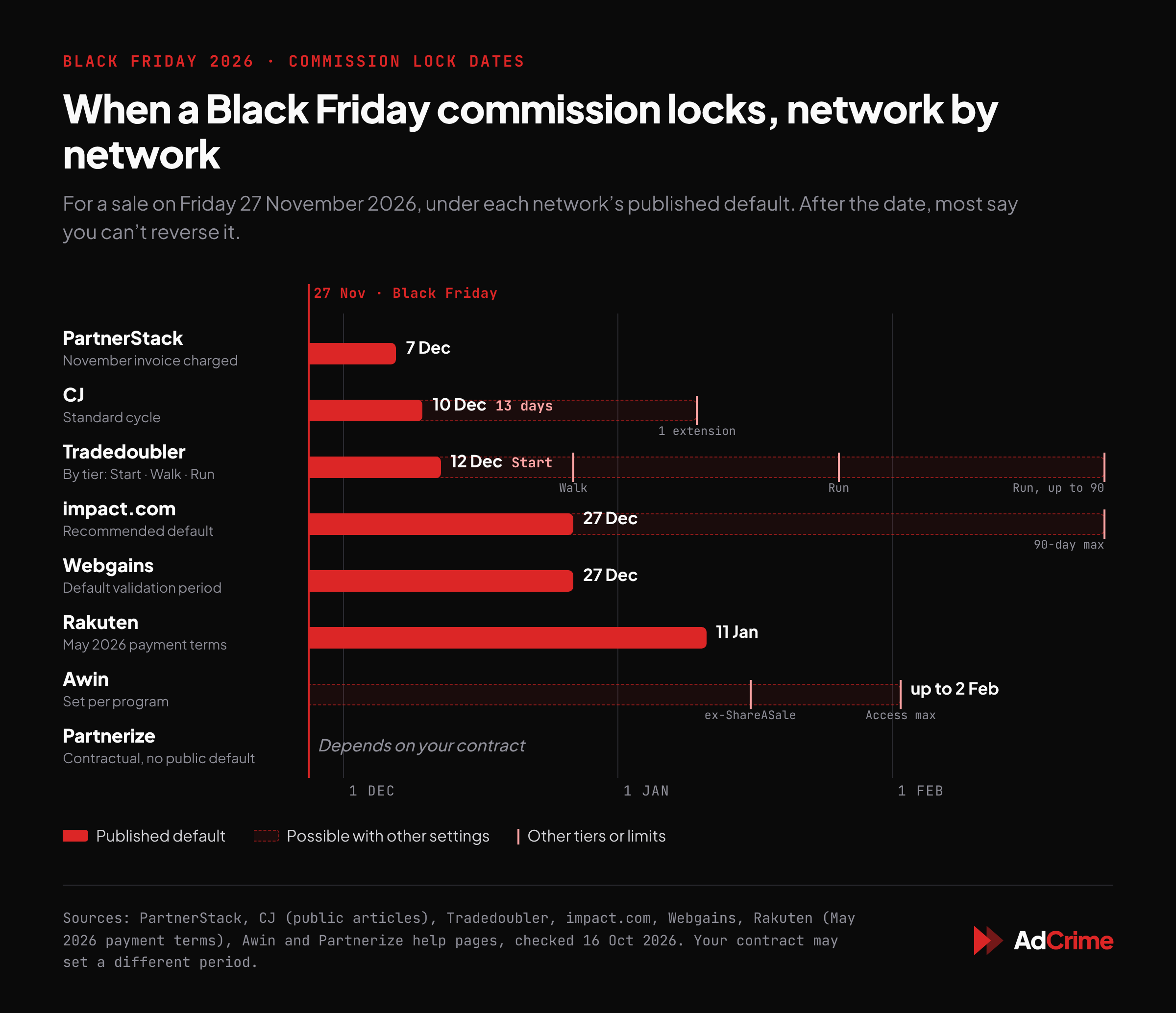
Most of these can be set differently in your contract, so treat the table as the question to ask your network, not the answer. Some of the dates fall on a weekend or over Christmas, so treat the working day before as the real deadline; the plan below does. None of the eight networks published a Black Friday extension that we could find.
After the date
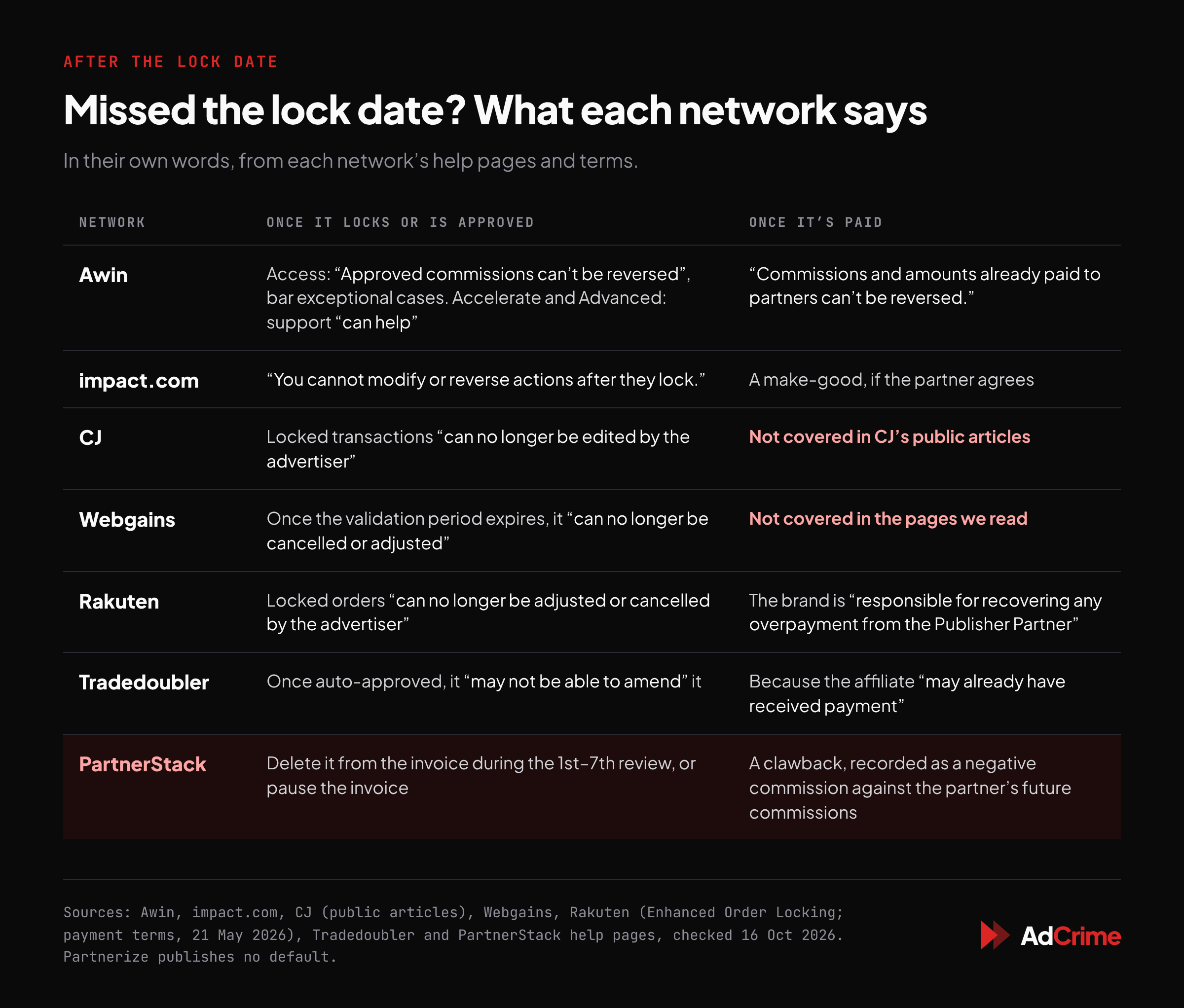
What each network's own pages say happens once a commission has locked or been approved:
- Awin: on Access, "Approved commissions can't be reversed", though support "may reverse commissions in exceptional cases"; on Accelerate and Advanced, support "can help reverse commissions". On every plan: "Commissions and amounts already paid to partners can't be reversed."
- impact.com: "You cannot modify or reverse actions after they lock." The fallback is a make-good, a payment the partner agrees to send back.
- CJ: locked transactions "can no longer be edited by the advertiser".
- Webgains: "After a Validation Period expires, it can no longer be cancelled or adjusted."
- Rakuten: locked orders "can no longer be adjusted or cancelled by the advertiser", and its payment terms make the brand "responsible for recovering any overpayment from the Publisher Partner".
- Tradedoubler: once auto-approved, "we may not be able to amend this since the affiliate may already have received payment."
- PartnerStack is the only one with a built-in way to recover commissions already paid out without the partner's agreement. "Once you have paid out commissions to a partner, under no circumstances can they be taken back", but a clawback, requested through PartnerStack, is recorded as a negative commission and recovered from that partner's future commissions on your program. That only works if they earn more from you.
Our guide to validation windows covers why the networks are built this way. For Black Friday, it means deciding before the date. Only CJ documents extending a single commission, and PartnerStack lets you pause an invoice. Elsewhere, changing the period, where it's allowed at all, goes through your settings or the network, so ask now.
The Black Friday ads are already running
In the first 12 days of November, 144 of the 3,423 affiliate ads we caught on branded coupon searches mentioned Black Friday or Cyber Monday. That's 4.2%, up from 1.6% in October (123 of 7,654), and already more than in the whole of October.
The sites behind them are mostly repeat offenders. Between 1 September and 12 November we caught 13,208 affiliate interceptions on 1,157 brands' coupon searches: ads that sent the click through the searched brand's own affiliate program (12,495 confirmed, 713 likely). 11,785 of them (89%) came from sites we had already seen doing it before September.
So most of the sites likely to show up on coupon searches in Cyber Week are already running ads now. Find the ones on yours and tie them to publisher IDs before 27 November, while you still have time to decline.
Read these as signals, not market rates: our brands are ones we chose to scan or that asked for a scan, some because known coupon sites were already advertising on them.
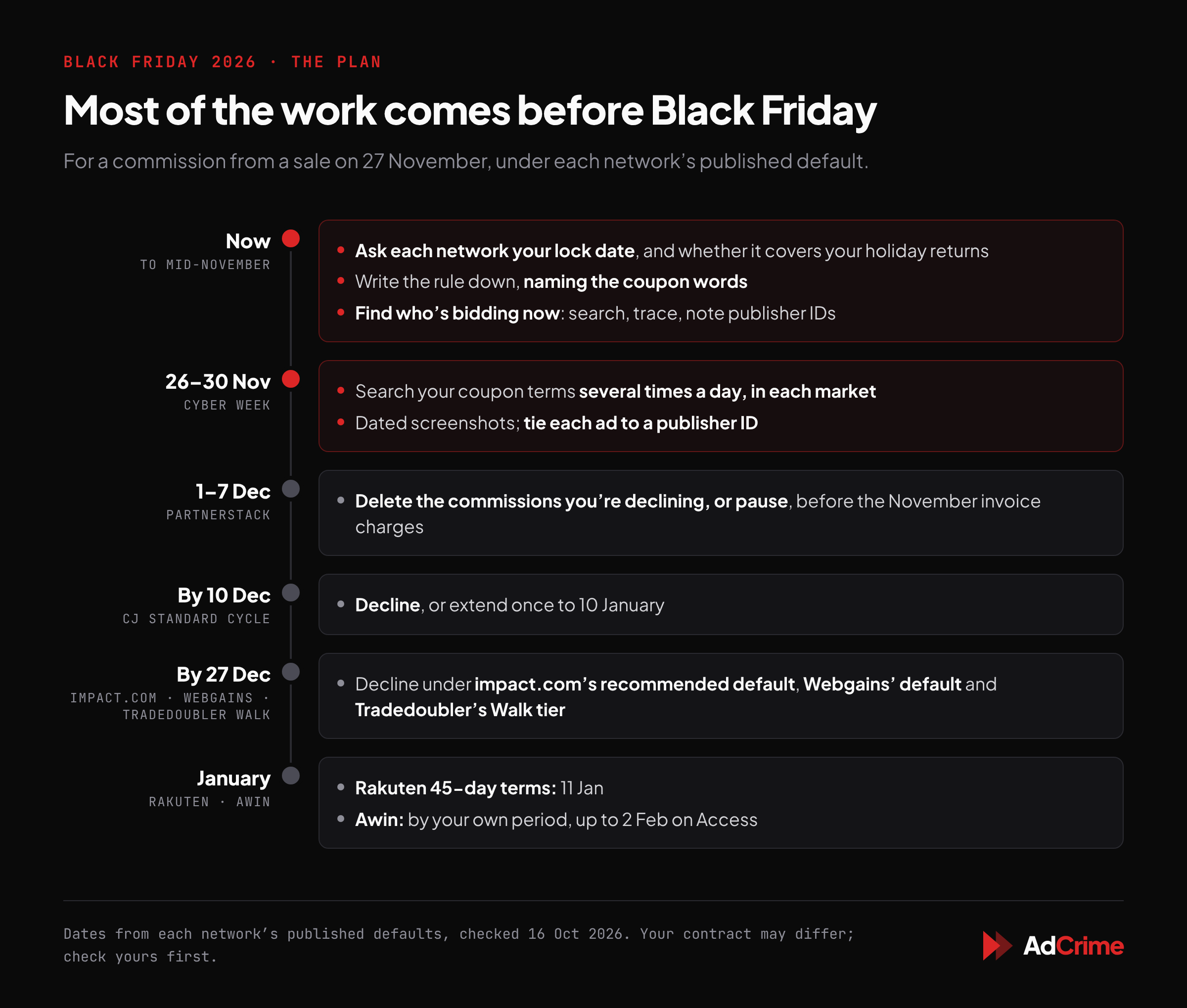
A dated plan, now to January
Now until 25 November
- Ask each network for your lock date. Use the table above as the question. Ask what your validation or locking period is, and whether it covers your holiday returns window. On Partnerize, ask for your Force Approval Period. On Awin a change goes through support and may need a contract addendum, so ask now.
- Put the rule in your program terms, naming the coupon words, and tell your publishers before 27 November. A decline is only as strong as the term it cites. "[Brand] promo code" is where we see these ads. Our brand-bidding policy template has a clause to copy. On most of these networks the paid search rule is set in each program's terms. Tradedoubler's paid search code of conduct is the clearest network-wide default we found: "Partners must not bid on any brand specific terms or trademarks of the brand, including its variations", unless agreed in advance.
- Find who is bidding now. Search your coupon terms ("[brand] promo code", "[brand] discount code", "[brand] voucher") in each market you sell in, at different times of day. Follow each affiliate ad down the redirect chain to the network and publisher ID. Write down the IDs. They're what you'll decline against in December.
Cyber Week, 26–30 November
- Search again, more often. Same terms, same markets, several times a day, with dated screenshots. These ads can be geo-targeted and timed, so one check from one place can miss them.
- Tie each ad to an account. A screenshot of a coupon site is not enough to decline a commission. The publisher ID is.
After Cyber Monday
- 1–7 December: PartnerStack. Delete the commissions you're declining from the November invoice, or pause it, before it charges at the end of 7 December.
- By 10 December: CJ standard cycle. Decline, or use the one extension to move the lock to 10 January while you check. That's a Sunday, so work to Friday 8 January. CJ's own fraud guidance suggests extending to allow "a longer period of review".
- By 11 December: Tradedoubler's Start tier. The lock date, 12 December, is a Saturday.
- By 24 December: impact.com's recommended default, Webgains' default and Tradedoubler's Walk tier. The lock date, 27 December, is the Sunday after Christmas.
- January: Rakuten (11 January under the 45-day terms) and Tradedoubler's Run tier (26 January at 60 days, later if your period is longer).
- Awin: by your own program's period. It can land in December or as late as 2 February on Access. Programs moved from ShareASale with a standard lock date lock on Saturday 16 January. Decline with the reason "Program terms violation"; Awin's validation guide lists "Illegitimate PPC activity" as an example.
Then file against the publisher account, not only the domain, so the same account isn't back on your coupon searches for the next sale.
The rules behind each date
- PartnerStack puts all of a month's commissions on one invoice. "You'll have 7 full days to review the invoice before it is auto-charged and payouts are released to your partners", and invoices are processed "at the end of the day 7th of each month", or the morning of the 8th depending on your timezone. You can pause an invoice if you need more time. Removing a commission from the invoice only moves it to the next one; to decline it, delete it.
- CJ's standard cycle: "transactions lock on the 10th of the month following the Event Date" (CJ). CJ also offers custom cycles of 7 to 60 days and open-ended ones. On the standard cycle, "Advertisers can only extend a commission for one additional pay period before it locks", which moves a Black Friday sale to 10 January.
- Tradedoubler sets the auto-approval period by tier: 15 days on Start, 30 on Walk, 60 on Run. Its page on changing the validation period says "We are unable to modify the auto-approval period" and gives Run as "up to 90 days", which would put a Black Friday sale at 25 February.
- impact.com "recommends the default locking period of 27 days after the end of the month they're tracked, but you can change this" (impact.com). So every November action locks around 27 December under that default, whether it tracked on the 1st or the 30th.
- Webgains: "Validation Periods are 30 days by default (although this can be higher if discussed and agreed with Webgains)" (Webgains).
- Rakuten Advertising's payment terms, last updated in May 2026, set the locking period at "forty-five (45)-days from the applicable transaction date", which the brand can change in writing. Rakuten is moving advertisers onto the impact.com platform in waves, and some programs show an auto-lock date for each order instead. Check which applies to yours.
- Awin sets an auto-validation period per program. The maximum depends on your plan: on Awin Access it's "Up to 67 days". It can't be switched off, and changing it means going through support, sometimes with a contract addendum (Awin). Awin recommends matching it to your returns or cooling-off period "plus an extra seven days". Programs moved over from ShareASale, which closed on 6 October 2025, with a standard lock date got a 50-day period: 16 January for a Black Friday sale.
- Partnerize describes a contractual "Force Approval Period" but publishes no default we could find.
What this can't tell you
- Your contract. Every rule above is a published default or maximum. Your program's settings may differ, and some networks set them per partner.
- CJ's current help pages. They need a login, so CJ's rules here come from its public articles, the latest from 2022.
- Partnerize and Rakuten in detail. Partnerize publishes no default; Rakuten runs more than one setup while it moves advertisers to impact.com.
- Your actual loss. It's your Cyber Week sales, times your affiliate share, times the share that came through ads on your own coupon searches, times your commission rate. Adobe credits affiliates and partners, influencers included, with 20.4% of US online retail revenue over the 2025 holiday season (Adobe, January 2026). The other inputs are yours, and we found no published, sourced figure for brand bidding's cost on Black Friday.
If you'd rather we watched your coupon searches through Cyber Week, the first scan is free.
Mario Vaher is the founder of AdCrime, which traces paid ads on branded coupon searches (public Google results, followed down the redirect chain) to the network and publisher account behind each one.